
Achilles Tendon Stiffness Training: Why Only the Heavy Leg Changed
In one 14-week study, both calves got stronger, but only one Achilles tendon got stiffer: the one trained with the heavier push. Eleven adults trained one leg with calf pushes against something that could not move (isometric pushes) at 55% of their hardest push, and the other leg at 90%, with the same total training volume on each leg. Only the heavy leg's tendon got stiffer, by about a third (Arampatzis et al., 2007). With the training volume matched, the load made the difference.
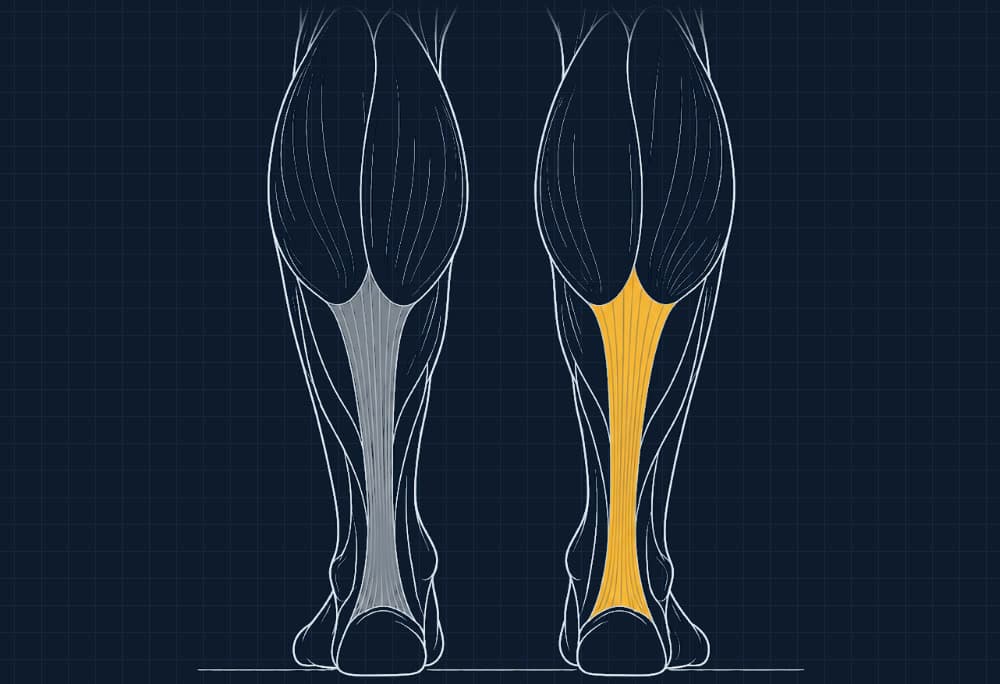
What does a stiffer tendon mean?
A stiffer tendon stretches less under the same force. After the 14 weeks in this study, the heavy leg's tendon stretched less than before at the same force (Arampatzis et al., 2007). Stiffness was worked out from how hard the calf pushed on the machine and how far the tendon stretched on ultrasound (Arampatzis et al., 2010; Tsai et al., 2024). These studies report tendon measurements and don't show a sprint-speed benefit; we come back to that below.
What did the 55% versus 90% study do?
In Arampatzis and colleagues' study, 21 adults aged 23 to 42 took part, none of them strength-trained; the 11 who trained in the study averaged 29.5 years old, and 10 more, also not strength-trained, were controls (Arampatzis et al., 2007). These 11, eight women and three men, sat on a lab ankle machine (a Biodex dynamometer) with the knee straight and pushed with the calf as if rising onto their toes, without the ankle moving, to match a target shown on a screen.
Each person trained one leg light, at 55% of max, and the other leg heavy, at 90%. Max means their hardest isometric push, measured on the machine; it is not a percentage of a one-rep max. Each rep was a 3-second push with 3 seconds off. The light leg did more reps per set, 7 against 4, so both legs trained at the same volume: how hard they pushed, added up over time.
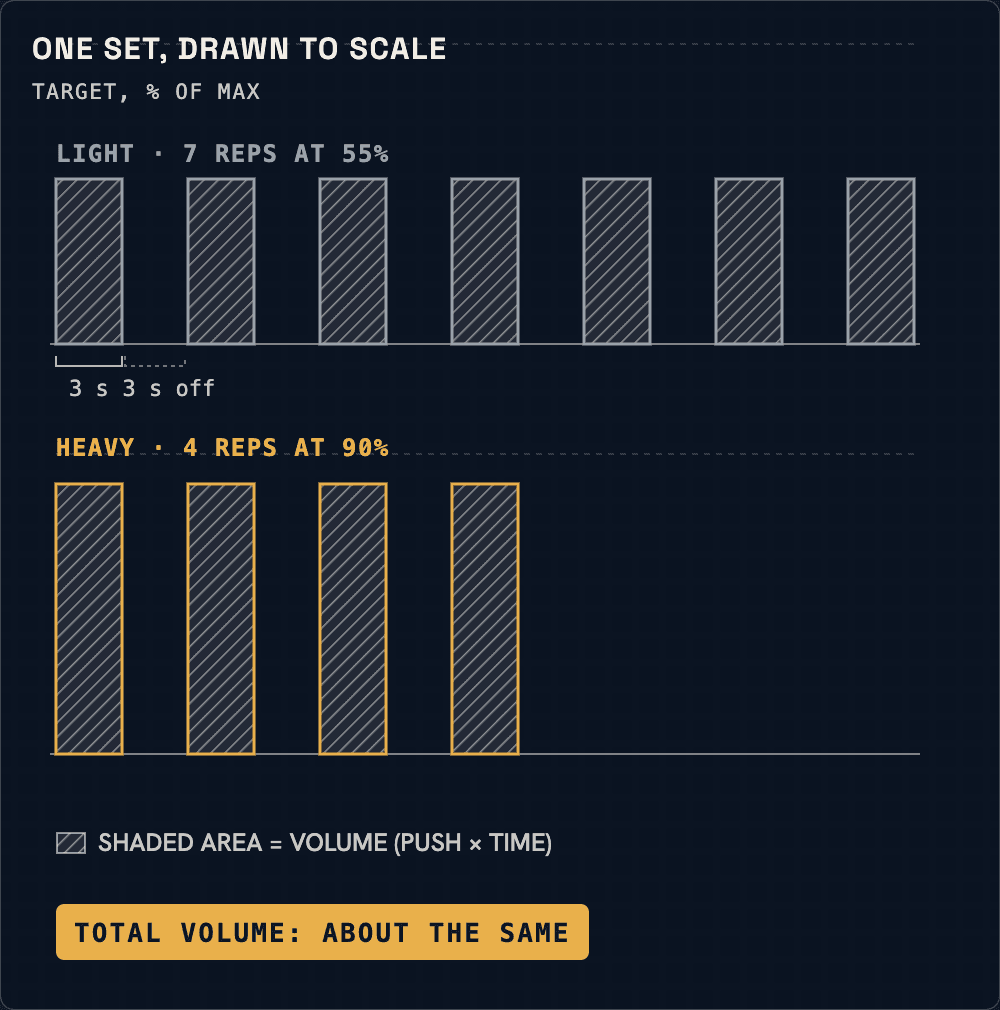
Our read: training both legs in the same people takes differences between people out of the comparison, and matching the volume means the light leg did not simply do less.
What changed after 14 weeks?
| After 14 weeks, 11 adults | Light leg (55% of max) | Heavy leg (90% of max) |
|---|---|---|
| Calf strength (hardest push) | +20% | +32% |
| Achilles stiffness | no clear change | +36% |
| Tendon thickness | no clear change | thicker in some regions |
Percent changes in the group averages, computed from the paper's table (Arampatzis et al., 2007). The light leg's stiffness rose 7.9% and its tendon thickness a little, both too little to rule out chance; a later meta-analysis's table lists them that way, with the same +36% for the heavy leg (Bohm et al., 2015).
Both calves got stronger. Only one Achilles got stiffer. So a calf that got stronger does not tell you the tendon changed with it.
Why did only the heavy leg's tendon change?
Every rep stretched the tendon, but not by the same amount. The light leg's pushes stretched the tendon by about 2.85% of its length and the heavy leg's by about 4.55%, so each heavy rep stretched it about one and a half times as far as a light rep (Arampatzis et al., 2007).
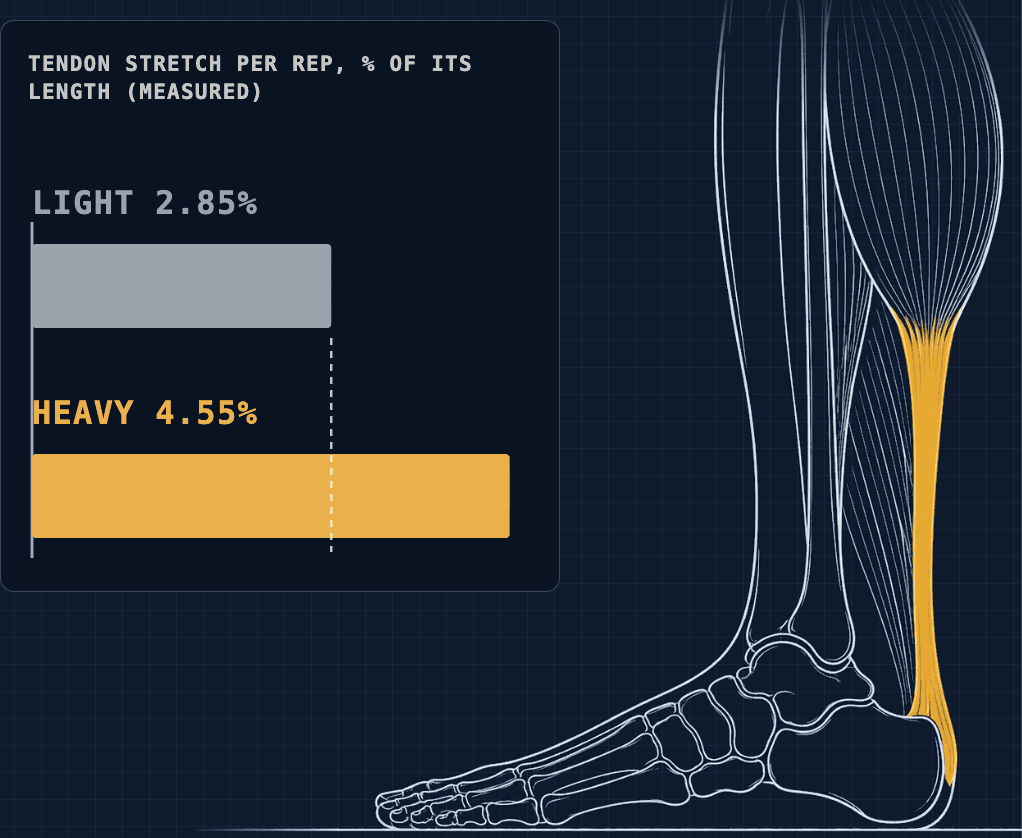
The researchers read this as evidence of a threshold: a tendon has to be stretched further than daily life stretches it before it changes. In their reading, the light pushes did not stretch the tendon enough to change it beyond what daily activities already do (Arampatzis et al., 2007), and their follow-up concluded that the stretch has to go beyond what everyday activities reach (Arampatzis et al., 2010). Where exactly that line sits is unknown: the study tested only two loads, and the light one brought no clear change.
Is this just one small study?
No, reviews point the same way. A 2015 meta-analysis of 27 studies found that stiffness gains depended on how heavy the loading was, not on the type of muscle contraction (Bohm et al., 2015). A 2022 meta-analysis of 61 articles found the largest tendon gains with training that stretched the tendon more rather than less (Lazarczuk et al., 2022). And a review of isometric training concluded that tendons need pushes of at least 70% of max, while muscle size and strength improved at lighter loads too (Oranchuk et al., 2019). That 70% is a cut-off drawn across many studies, not a threshold measured in one.
What was the exact dose?
| The heavy leg's dose | Arampatzis et al. (2007) |
|---|---|
| Load | 90% of max, isometric (pushing without moving) |
| Each rep | 3 s push, 3 s off |
| Per session | 5 sets of 4 reps |
| Per week | 4 sessions |
| Block | 14 weeks |
| Set-up | lab dynamometer, knee straight, target on a screen |
| Rest between sets | not reported; a later study from the same group used 2 minutes (Tsai et al., 2024) |
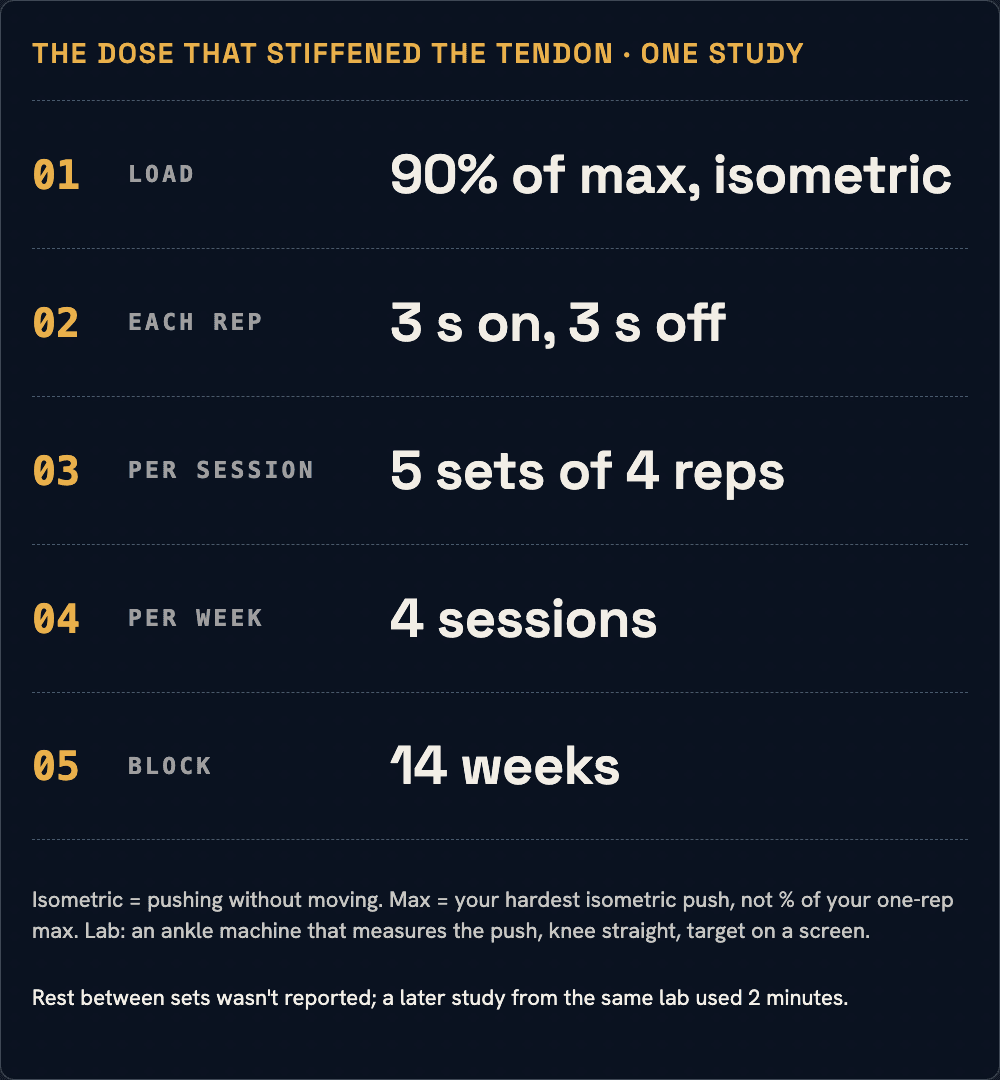
The same group later proposed nearly the same program, five sets of four contractions at 85 to 90% of max, for young athletes at risk of tendon problems (Mersmann et al., 2017). That was a proposal, not a trial of the program as written.
Do longer holds or quicker reps work better?
The same group tested both, and the 3-second push came out ahead each time: it beat 1-second reps, and four of them beat one 12-second hold.
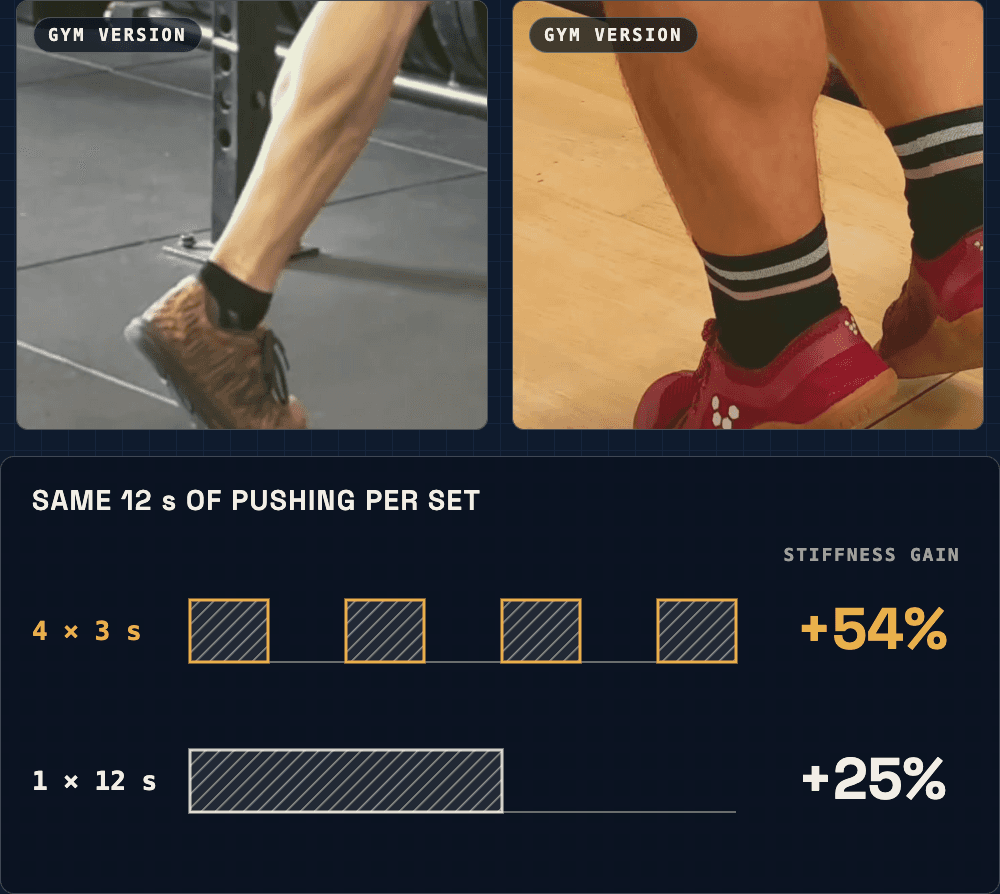
Longer holds. In a follow-up, 12 active men trained one leg with four 3-second pushes per set and the other leg with one 12-second hold per set, at 90% of max, with the same 12 seconds of pushing per set. Stiffness rose 54% with the short pushes and 25% with the long hold (Bohm et al., 2014; values for these 12 men as tabulated by Bohm et al., 2015). Longer holds worked too, but four short pushes beat one 12-second hold.
Quicker reps. In 2010, the same group used 1-second pushes with 1 second off, at about the same volume, in 11 men. Stiffness rose 17%, against 36% with the 3-second reps in 2007 (Arampatzis et al., 2010; values as tabulated by Bohm et al., 2015). From that, the authors concluded that holding the stretch longer in each push gives a better tendon response (Arampatzis et al., 2010). That comparison is between two separate groups of people, so it is weaker evidence than the one-leg-each-way designs above.
Our read: longer helped only up to a point. A 3-second push beat a 1-second one, but one 12-second hold lost to four 3-second pushes.
How long does it take, and how often should you train?
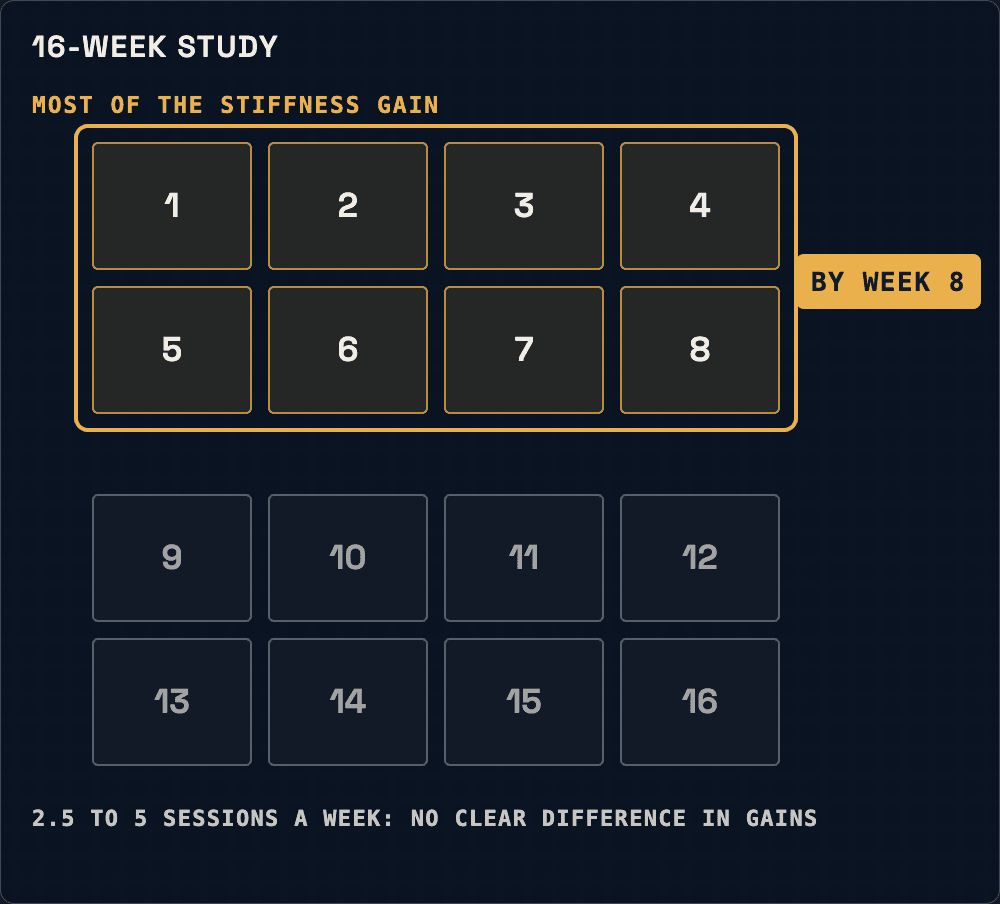
In a 2024 study from the same group, 39 recreationally active men aged 19 to 40 trained for 16 weeks at 90% of max, in sets of four 3-second pushes with 3 seconds off and 2 minutes between sets. Each leg got one of five schedules, from 2.5 to 5 sessions a week and 180 to 300 seconds of heavy pushing a week. Most of the stiffness gain came within the first 8 weeks, and the schedules showed no marked differences (Tsai et al., 2024). Those first 8 weeks included a 3-week start with reduced loading. The authors add that it is unclear whether the results transfer to women, other age groups or patients.
Does a stiffer Achilles make sprinters faster?
These studies don't show it. All four trained active adults, mostly men, not sprinters, with 11 to 39 people training in each, and sprint speed is not among the outcomes their abstracts report (Arampatzis et al., 2007, 2010; Bohm et al., 2014; Tsai et al., 2024).
The isometric-training trials we found that did time sprints used team-sport players and a different exercise. In one, 24 floorball players were split into a control group and two groups that replaced two sets of squats with isometric squats; the isometric groups improved their sprint times more than the control group (Lum et al., 2023). That was a squat, not a calf push, in floorball players, not track sprinters.
So treat a stiffer Achilles as a tendon goal, not a promise of speed.
How would we use it?
These are our rules of thumb, built from the studies above, not a tested plan for sprinters.
- Keep the load high. For the tendon, the reference is pushes near 90% of max. The 55% leg showed no clear change.
- Start from the studied dose. 3-second pushes with 3 seconds off, 5 sets of 4, about 4 sessions a week.
- Give it time. Judge it after 8 to 14 weeks, not after two.
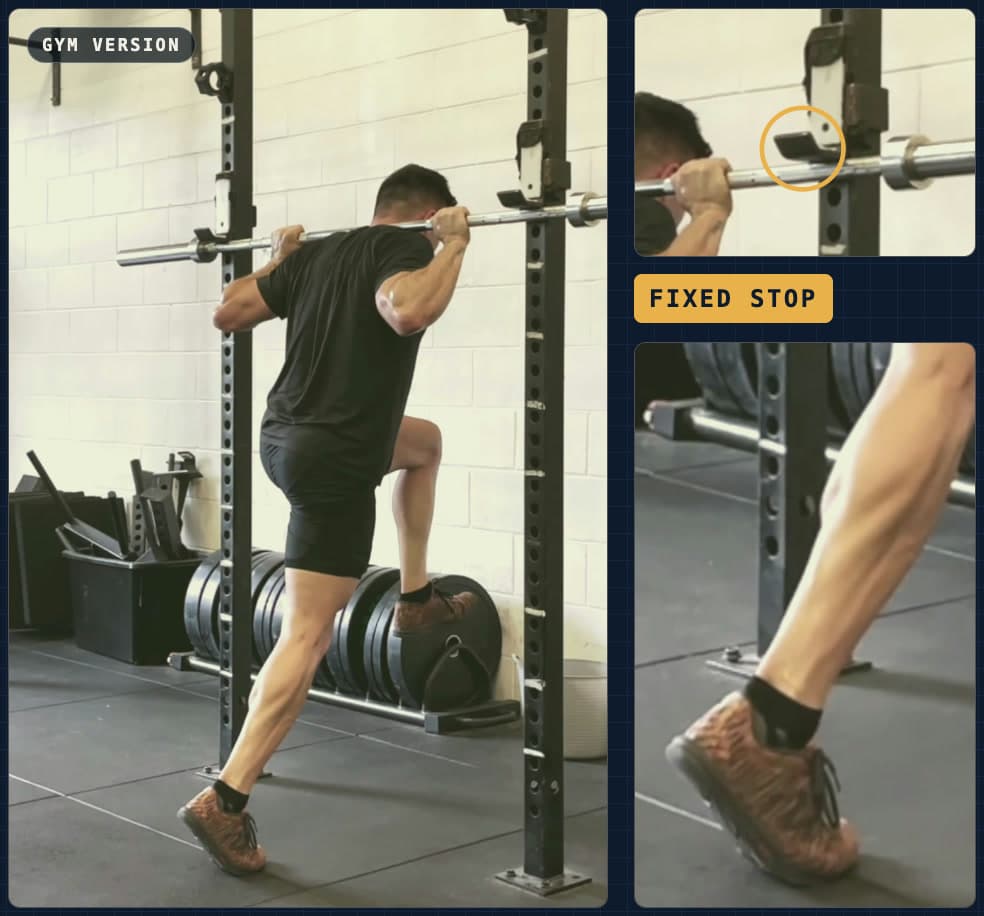
- In a gym, push into something that can't move, with the knee straight: a bar under pinned safeties, or a strap. Without a force gauge you can't measure 90%, so push close to your hardest and keep the push steady for the full 3 seconds. The gym version is a rule of thumb, not the studied set-up.
- Plan the week around it. In the 2007 study the calf pushes were the participants' only organised training (Arampatzis et al., 2007), so where the sessions sit in a sprinter's week is a coaching call the studies don't answer.
Key takeaways
- In one study, pushes at 90% of max stiffened the Achilles by about a third in 14 weeks; pushes at 55% with the same volume brought no clear change.
- Both calves got stronger, so calf strength alone doesn't tell you the tendon changed.
- In the same group's follow-ups, 3-second pushes beat both 1-second reps and one 12-second hold.
- In a 16-week study, most of the stiffness gain came by week 8.
- These were active adults, mostly men, not sprinters, and no sprint-speed benefit was shown.
FAQ
- Is 90% of max the same as 90% of 1RM?
- No. In these studies, max is your hardest isometric push against something fixed, measured on a dynamometer. A one-rep max is the heaviest weight you can lift once.
- Do heavy calf raises work, or only isometric pushes?
- Across 27 studies, tendon stiffness gains depended on loading intensity, not on the type of contraction (Bohm et al., 2015). Our read: heavy calf raises are a reasonable route to a stiffer tendon. The head-to-head evidence in this post is isometric.
- How much rest between sets?
- The 2007 paper doesn't report it. A 2024 study from the same group used 2 minutes (Tsai et al., 2024).
- How many sessions a week?
- The 2007 dose was 4 sessions a week. In the 2024 study, schedules from 2.5 to 5 sessions a week showed no marked differences (Tsai et al., 2024).
Images: blueprint illustrations drawn for this post. Gym stills from "Calf iso pin push" (Science Of Fitness) and "Barbell Isometric Calf Raise // Achilles Rehab" (SPARC Physiotherapy), YouTube.