
What Limits Top Speed? Four Studies Point to Ground Force
Want more top speed? You'd think it comes from quicker legs. But in one study of 33 people, a leg's time in the air didn't clearly change with top speed. The faster runners hit the ground harder: for their body weight, the fastest pushed about a quarter harder into the ground, on average (Weyand et al., 2000). A second study suggests why slower runners can't just push harder: the authors concluded that the limit is the short time the foot has to push, not how much force the legs can make (Weyand et al., 2010). That time is very short. In the world's fastest sprinters at top speed, the foot was down for under a tenth of a second (Taylor & Beneke, 2012).
These four studies measured; they didn't train. The coach section below lists what training studies found, and in whom.
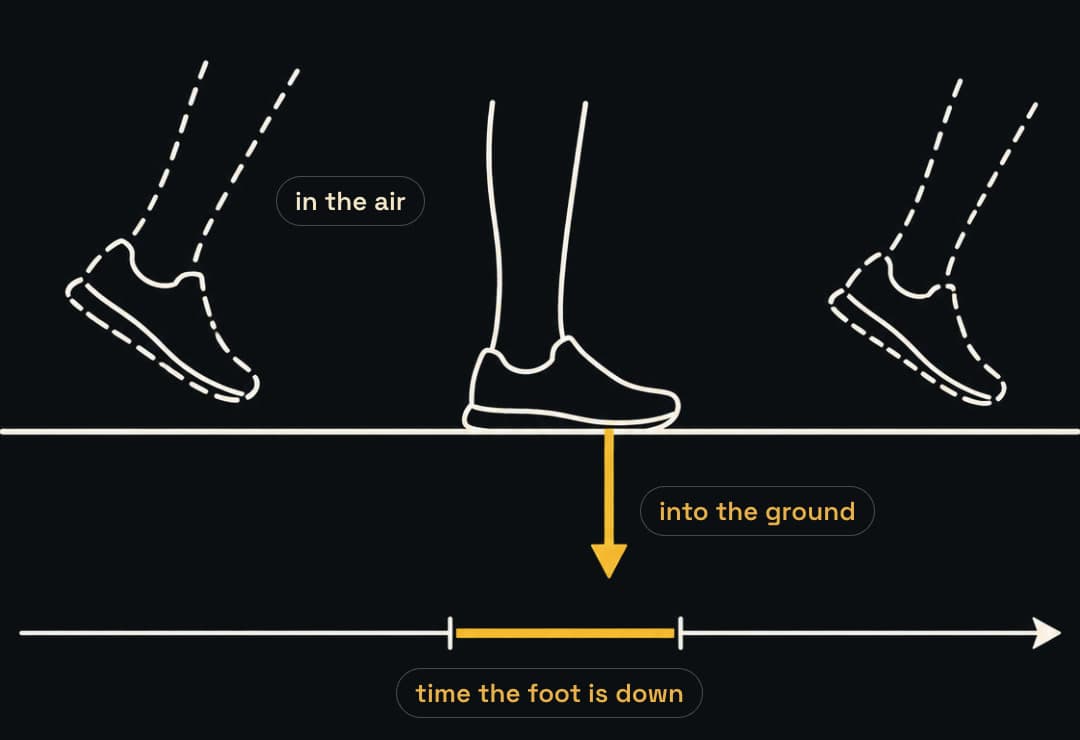
What do “time in the air” and “force into the ground” mean?
Time in the air is swing time: how long a foot is off the ground before it lands again (Weyand et al., 2000).
Force into the ground is how hard the foot pushes down while it is on the ground, compared with body weight and averaged over each landing (Weyand et al., 2000). In the figures, the gold arrow shows that push.
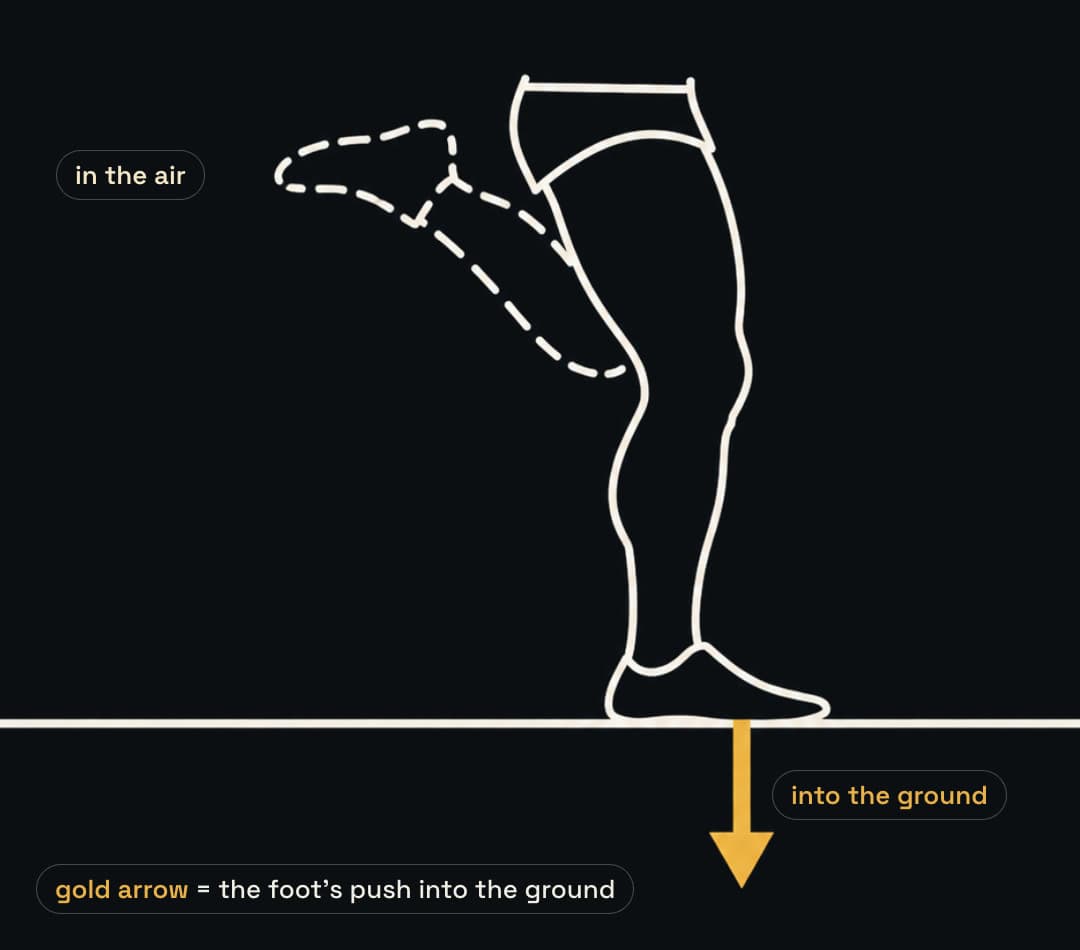
Do faster runners move their legs faster through the air?
Not by this measure, in one study. Weyand and colleagues tested 33 people of different sprinting abilities at their top speeds on a level treadmill with a force plate built in. Their top speeds ran from 6.2 to 11.1 m/s, so the fastest was nearly twice as fast as the slowest. A leg's time in the air didn't clearly change with top speed. The force into the ground did: for their body weight, the fastest pushed about a quarter harder into the ground, on average (Weyand et al., 2000).
| Weyand et al. (2000): 33 people, top speed on a treadmill | What the study found |
|---|---|
| Top speed | 6.2 to 11.1 m/s, a 1.8-fold range |
| Time in the air (swing time) | didn't clearly change with top speed (no clear relationship, P = 0.18) |
| Force into the ground (average while the foot is down, for body weight) | about a quarter more at 11.1 m/s than at 6.2 m/s (1.26 times) |
The same paper ran a second test in five people, running at top speed downhill and uphill. Their faster downhill speeds came with more force into the ground (1.3 times as much), while their shortest times in the air were similar, about 8% apart (Weyand et al., 2000). From both tests, the authors concluded that faster top speeds come from pushing harder on the ground rather than from swinging the limbs through the air more quickly (Weyand et al., 2000).
Time in the air is not the same thing as step rate, the number of steps per second. In another study, 102 male sprinters ran 60 m sprints over a long force platform. Grouped by top speed, they differed in step rate, averaged over all steps (Nagahara, 2023). So the finding above is about the leg's time in the air, not about step rate.
When in the step does the extra force come?
Early. Clark and Weyand compared seven competitive sprinters with seven athletes who were not sprinters, on a high-speed force treadmill. The sprinters reached higher top speeds by pushing harder just after the foot landed, in the first half of the time it was down. In the second half, the two groups were similar (Clark & Weyand, 2014).
| Clark & Weyand (2014): 7 sprinters vs 7 other athletes | Sprinters | Other athletes |
|---|---|---|
| Top speed | 10.4 m/s | 8.7 m/s |
| Force in the first half of the foot's time down (× body weight) | 2.65 | 2.21 |
| Force in the second half (× body weight) | 1.71 | 1.73 |
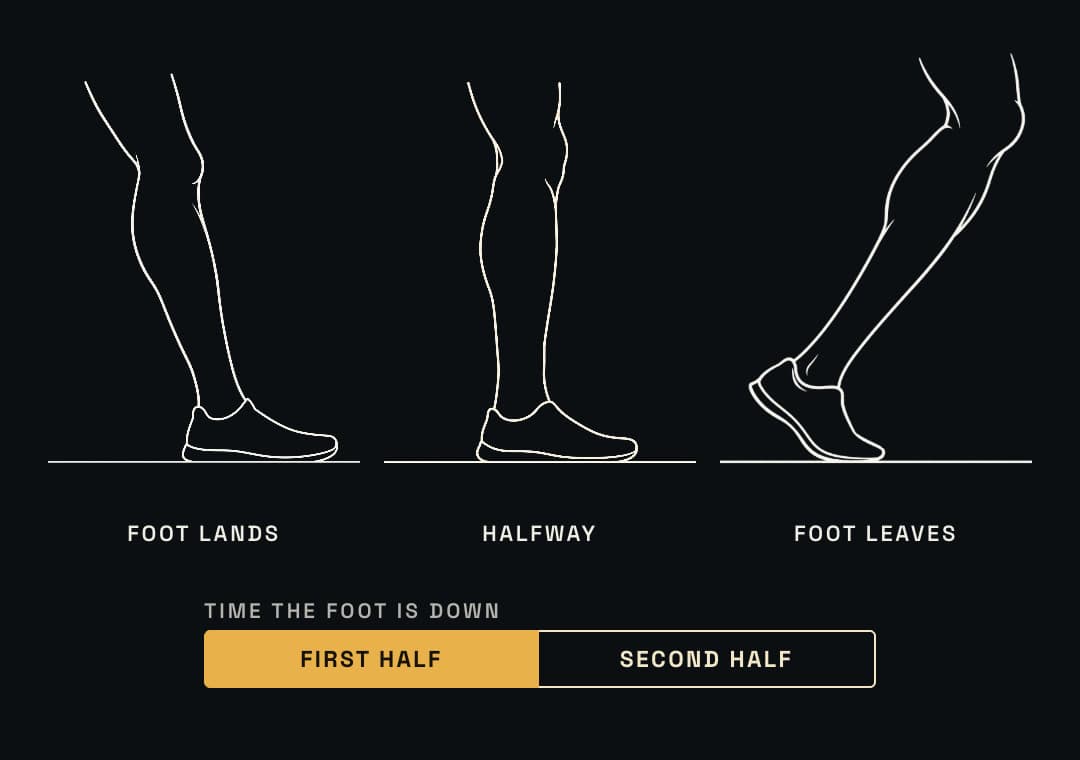
This is the only one of the four studies that compared sprinters with other athletes, and it had seven people in each group.
Why can't slower runners just push harder?
Because in one study, the same legs pushed harder when hopping than when sprinting. Weyand and colleagues had seven athletic people run on a treadmill at faster and faster speeds until they couldn't keep up, to find their top speed in forward running, in one-legged hopping and in backward running. At top speed, hopping on one leg put more force into the treadmill than sprinting did. But on average, the foot stayed down longer when hopping (Weyand et al., 2010).
| Weyand et al. (2010): 7 athletic people, at top speed | Sprinting | Hopping on one leg |
|---|---|---|
| Average vertical force (× body weight) | 2.08 | 2.71 |
| Peak vertical force (× body weight) | 3.62 | 4.20 |
| Foot on the ground (average of these 7 people) | 0.108 s | 0.160 s |
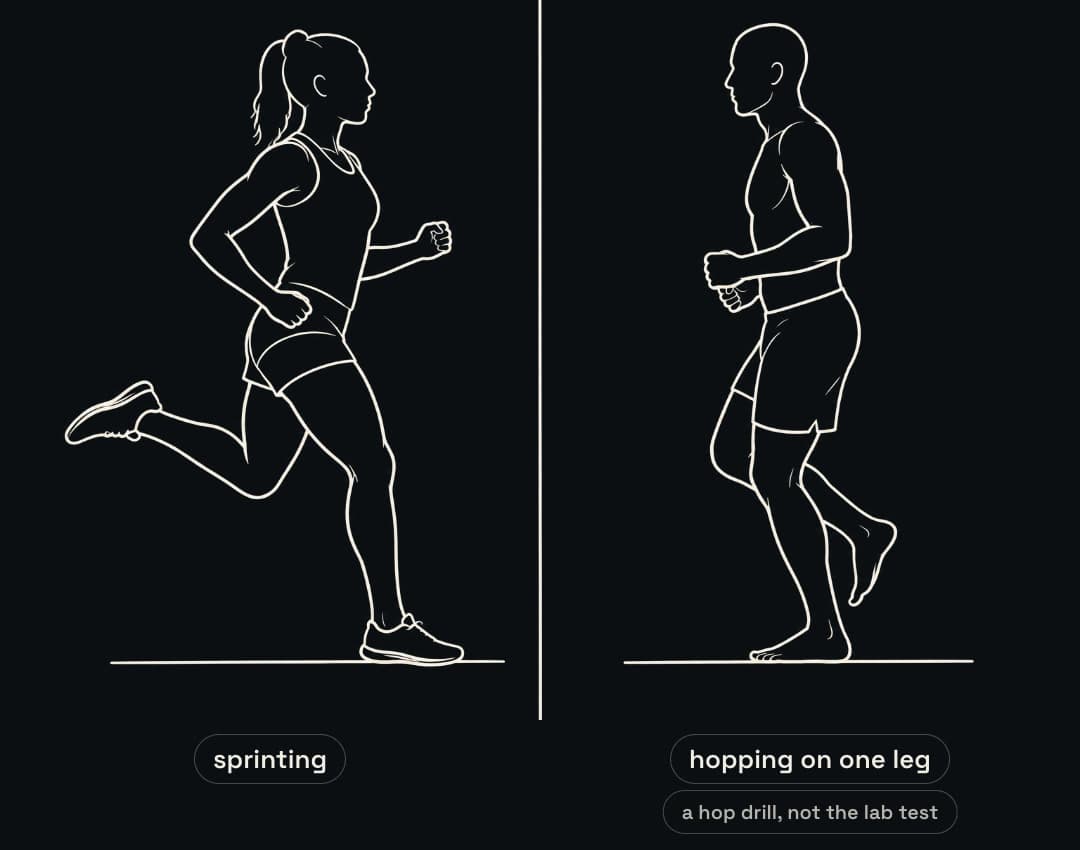
So the legs didn't run out of force. They ran out of time. The authors concluded that, while the foot is down, the limit is the short time it has to push hard, not the most force the legs can make (Weyand et al., 2010).
Does leg speed still matter?
Yes. Time in the air and thigh swing are different measures: one is how long the leg is off the ground, the other is how fast the thigh turns. Clark, Meng and Stearne measured the leg motion of 40 people (20 men, 20 women) from various athletic backgrounds running 40 m at speeds from easy to maximal, 3.1 to 10.0 m/s. Across all those runs, the faster the thigh swung, the faster they ran, and the faster the lower leg came down at touchdown. Both links were strong (R² above 0.70 for running speed, and 0.75 for the lower leg's downward speed). The authors suggest that thigh speed is linked to running speed and to how the leg lands, which is tied to the force into the ground (Clark et al., 2020).
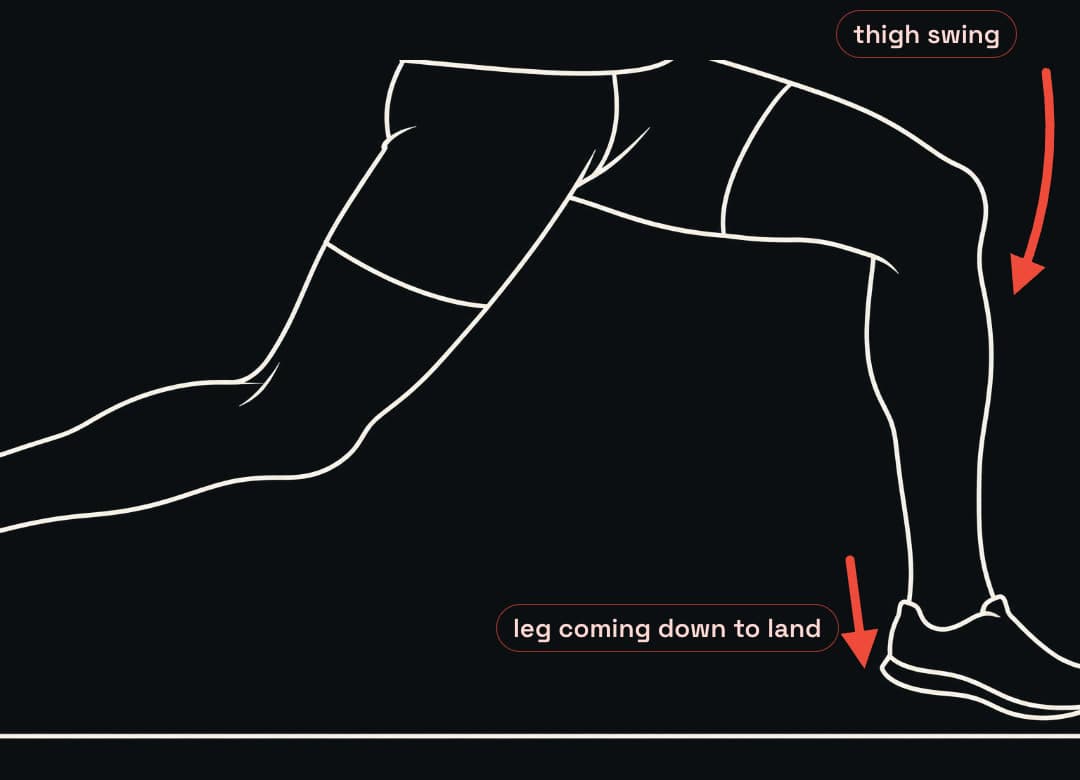
That study reports leg motion, not force, and it mixed slow and flat-out runs from people of different sports. Our read: leg speed and ground force are not rivals here. In Weyand's study, the leg's time in the air did not clearly separate fast runners from slow ones, while the force on the ground did.
What do these studies not show?
- One sprinter comparison. Only Clark and Weyand (2014) compared sprinters with other athletes, seven against seven. The others tested 33 people of mixed sprinting ability, 7 athletic people and 40 people, recreational to track & field.
- Mostly treadmills. Three of the four studies measured force on a treadmill, not on a track.
- No training. None of these four studies tested a training plan, so none shows which exercise raises the force.
- Links, not cause. Clark et al. (2020) found that thigh speed and running speed rose together across runs; that alone doesn't show that one causes the other.
What should a coach do with this on Monday?
These four studies measured; they didn't train. Training studies did test programmes. Here is what four lines of them found, and in whom:
- Sprint near top speed. In recreationally active adults, one weekly session of 30 m flying sprints at 90 to 95% of top speed for 6 weeks improved 10 to 30 m sprint performance, against a control group that did no extra training. Every gain was trivial to small (Skoglund et al., 2023).
- Add jump training. In track and field athletes of any level, adding plyometric (jump) training to their usual training cut 30 m sprint times by about 3.5%, in a meta-analysis of randomised trials (Weerasinghe et al., 2026).
- Try complex training. In one randomised trial of 48 elite track athletes, three extra programmes (weights, jumps or complex training, three sessions a week for 12 weeks on top of sprint practice) all improved sprinting more than regular training did. Complex training improved sprint velocity the most, and weights built the most maximal strength (Li, 2025).
- Load the calf heavy for the tendon, and jump for the ankle. In 11 adults who didn't strength train, 14 weeks of calf loading at high tendon strain stiffened the Achilles tendon; their other leg, loaded at low strain with similar frequency and volume, showed no clear increase in stiffness (Arampatzis et al., 2007). The loading ran 3 s on and 3 s off, as the same lab's follow-up in 11 men (23.9 ± 2.2 y) describes (Arampatzis et al., 2010). In 10 untrained men, heavy calf raises stiffened the tendon with no clear change at the ankle, and hops and drop jumps stiffened the ankle with no clear tendon change (Kubo et al., 2007).
None of these studies measured ground force at top speed. Our read: use them as starting points, and judge each by what happens to the athlete's own top-speed times. Related: what a sprint session should actually look like and training load for sprinters.
FAQ
- Do faster runners move their legs faster?
- It depends what you measure. In one study of 33 people, a leg's time in the air didn't clearly change with top speed, while the force into the ground did (Weyand et al., 2000). In another study, across runs from slow to flat-out, the faster the thigh swung, the faster people ran (Clark et al., 2020).
- How long is the foot on the ground at top speed?
- Under a tenth of a second in the world's fastest sprinters. Taylor and Beneke analysed the three fastest men of the time, using data from the 2009 World Championships: the fastest of them reached 12.3 m/s between 60 and 80 m with the foot down for 0.091 s, and his two rivals' contacts were shorter than his (Taylor & Beneke, 2012). The 0.108 s in the table above is the average of seven athletic people sprinting on a treadmill (Weyand et al., 2010).
- Can you train this?
- These four studies didn't test training, but training studies have. Adding jump training cut 30 m times by about 3.5% in track and field athletes (Weerasinghe et al., 2026), and heavy calf loading stiffened the Achilles tendon in adults who didn't strength train (Arampatzis et al., 2007). None of them measured top-speed ground force. The coach section above has all four findings and who was studied.
Figures: our drawings. The body positions are traced from NBC Sports and World Athletics race replays and from The Barefoot Sprinter on YouTube.