
Does a Bigger Squat Make You Faster? What the Sprint Studies Show
Squat strength and sprint speed are linked, but the link doesn't show that a bigger squat makes you faster. Across fifteen studies, squat gains and sprint gains tended to rise together (Seitz et al., 2014). In 21 well-trained sprinters, squatting more for their body weight was linked to faster times at every distance tested (Requena et al., 2011). But when three reviews and one trial compared training types, strength training never came out ahead. Max-strength training gained less sprint speed than reactive-strength or combined training in female team-sport players (Hughes et al., 2023). Strength, jump and combined training gave about the same sprint gain in top male youth soccer players (Oliver et al., 2024). Olympic lifts did no better than other training, or no training (Crenshaw et al., 2024). And in one trial of elite track athletes, weights gained less than complex training (Li, 2025).
Our read: strength training can help, but it isn't proven that a bigger squat makes you faster. Judge any lift by what it does to your sprint times.
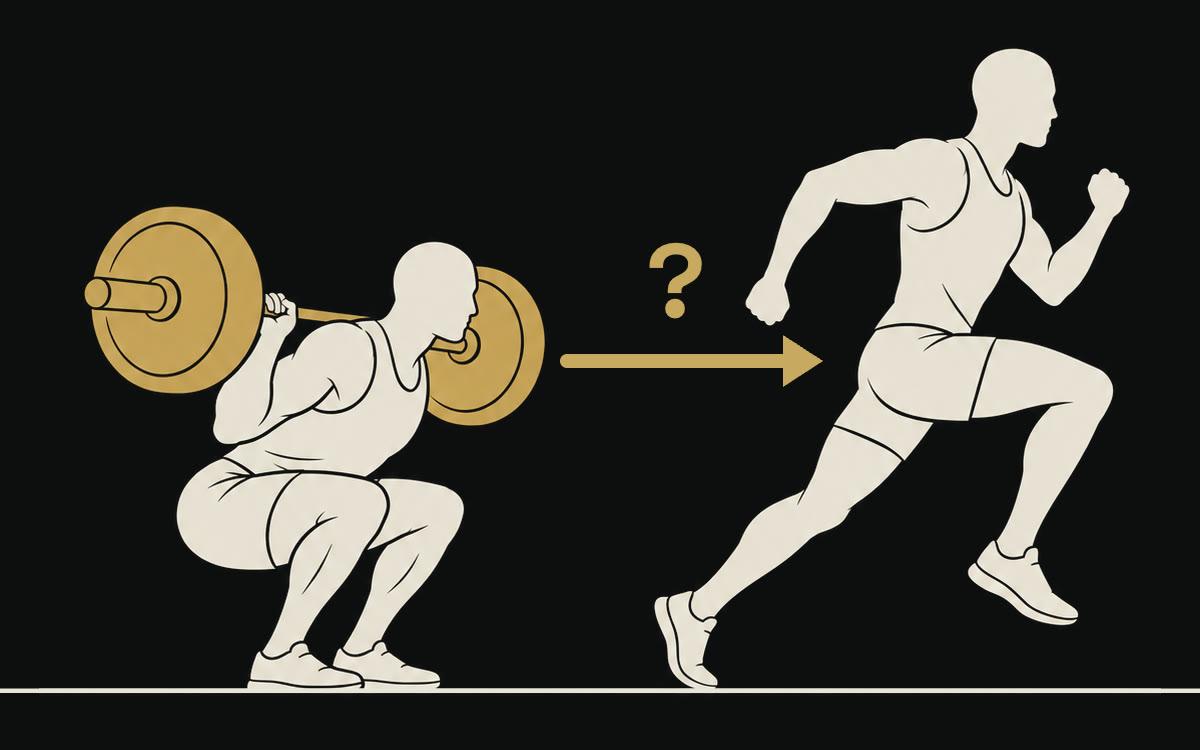
Why do coaches argue about squats and sprinting?
One camp says strength can help sprinting. A review of strength and athletic performance notes that a lot of research backs the idea that greater muscular strength can improve sport skills such as jumping and sprinting (Suchomel et al., 2016).
The other camp says a squat isn't a sprint. An earlier review argued that squats and jump squats, which push the body straight up on two legs, carry over little to sprinting, and it stressed matching the movement and the speed at which the muscles work (Young, 2006).
Part of their case is time. A study of the three fastest men of the time used race data from the 2009 World Championships. One of those sprinters had his foot on the ground for 0.091 seconds at top speed, over the 60 to 80 m section where he reached his greatest velocity (Taylor & Beneke, 2012). An elite sprinter's heavy squat we timed from training video took 1.4 seconds to push from the bottom to the top (our own timing of one rep).
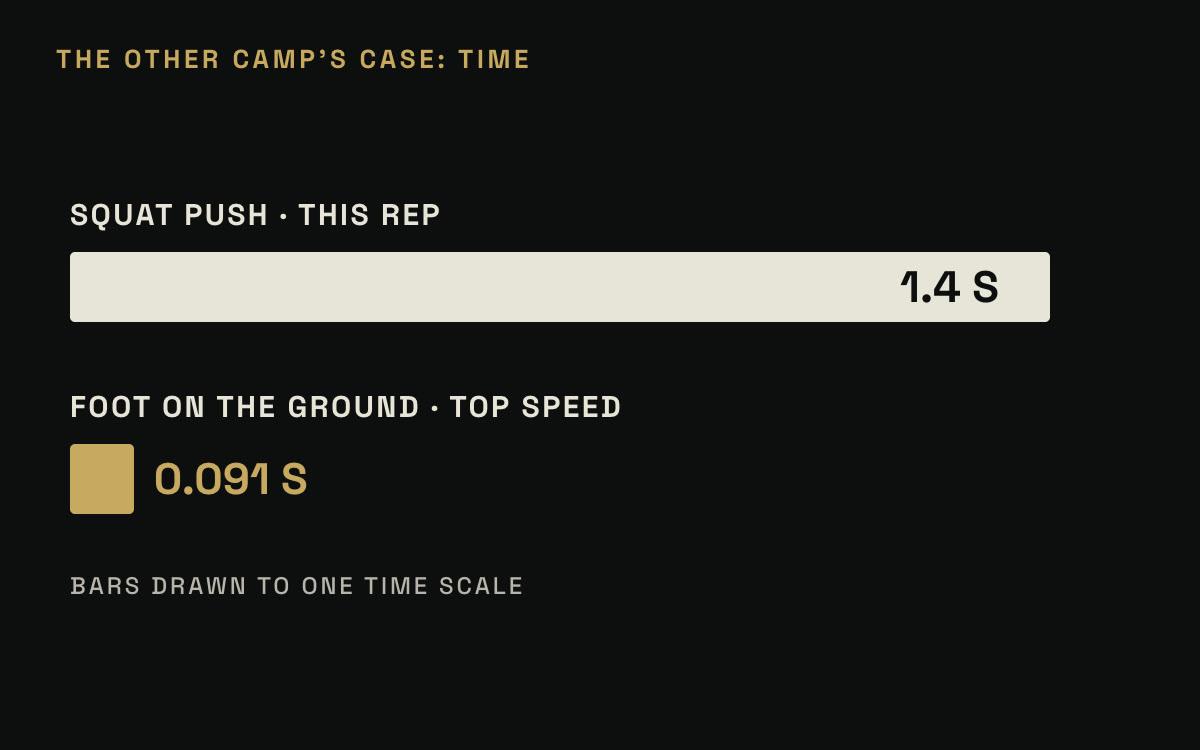
That comparison is the other camp's case, timed on one rep and one step. It shows the two movements are very different. It can't show whether squat training carries over to the sprint. For that, look first at what goes with sprint speed, then at what happens when athletes train.
Is squat strength linked to sprint speed?
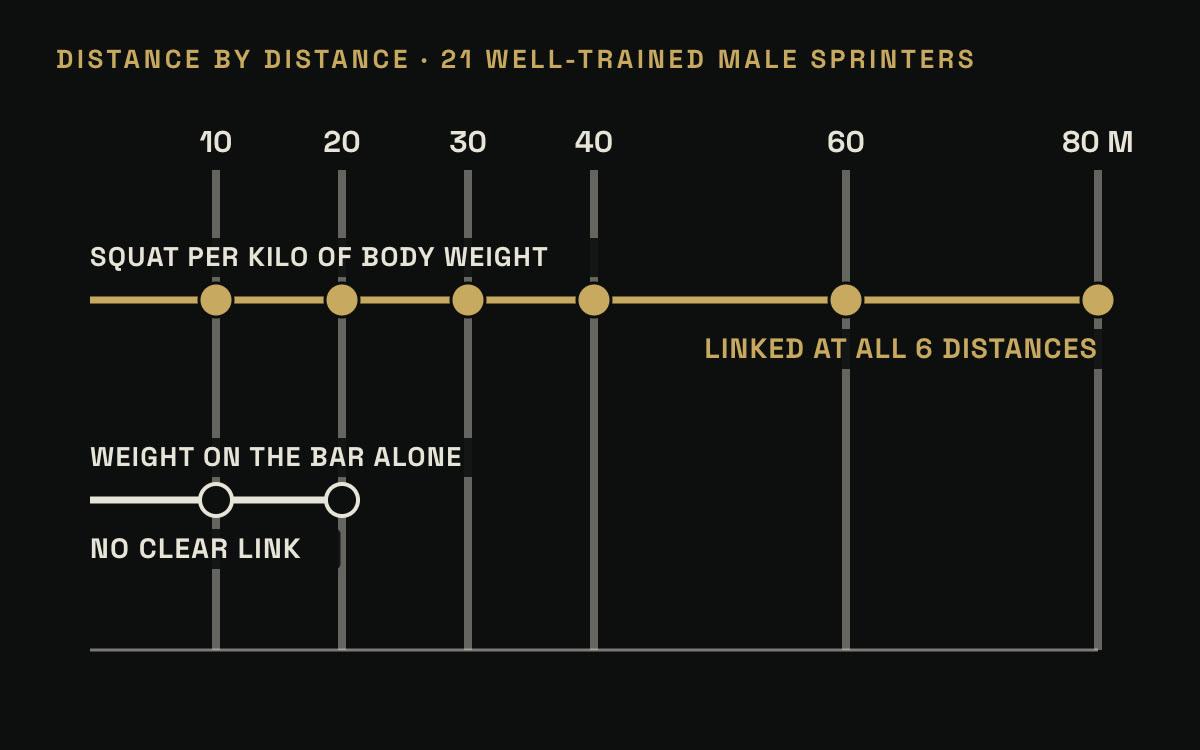
In trained sprinters, yes, when the squat is measured for body weight. Requena and colleagues tested 21 well-trained male sprinters on a one-rep-max barbell squat and on sprints over 10, 20, 30, 40, 60 and 80 m. Squat strength for body weight was linked to faster times at all six distances (correlations from −0.49 to −0.59; negative because more strength went with a lower, faster time). The weight on the bar alone showed no significant link with 10 m and 20 m times (Requena et al., 2011).
Strength for body weight is usually given in kilos lifted per kilo of body weight (Comfort et al., 2012). Here is what that means with two made-up lifters on the same bar:
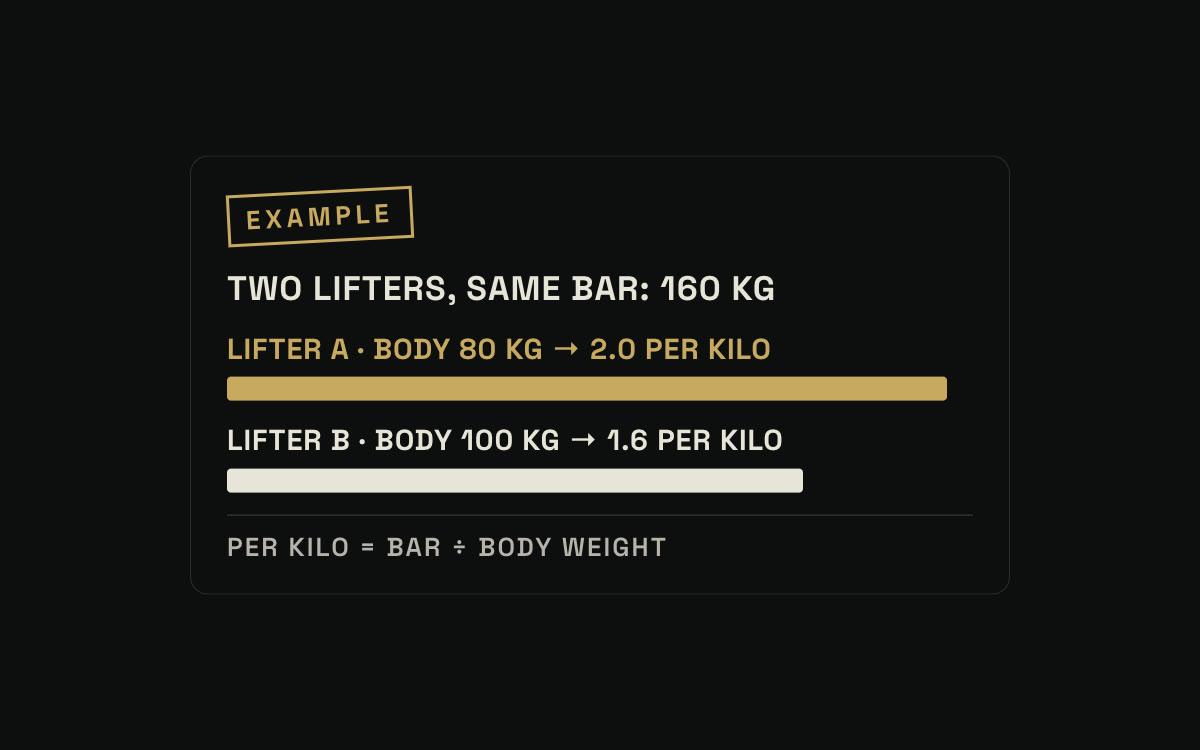
Same bar, but lifter A squats more for their body weight. That per-kilo number is the one that lined up with sprint times in Requena's sprinters.
| Distance | Squat per kilo of body weight | Weight on the bar alone |
|---|---|---|
| 10 m | linked | no clear link |
| 20 m | linked | no clear link |
| 30 m | linked | not in the study summary |
| 40 m | linked | not in the study summary |
| 60 m | linked | not in the study summary |
| 80 m | linked | not in the study summary |
Requena et al. (2011), 21 well-trained male sprinters. "Linked" means a significant correlation; the study's summary gives one range for all six distances (r = −0.49 to −0.59), not a value per distance, and gives the bar-weight-alone result only at 10 and 20 m.
Other groups show a similar pattern for raw strength. In 26 professional rugby league players, the three-rep-max squat did not correlate significantly with 5, 10 or 30 m times, while jump-squat and countermovement-jump measures did (r = −0.43 to −0.66) (Cronin & Hansen, 2005).
A jump test shows a link too. In a review of 27 studies of well-trained adults over 18, Lin and colleagues found standing-long-jump distance more strongly linked to maximal-speed times (r = −0.73) than to acceleration times (r = −0.45) (Lin et al., 2023).
The link also shows up across training groups. Seitz and colleagues combined 15 studies with 510 subjects (26 training groups and 11 control groups). Groups with bigger squat-strength gains tended to show bigger sprint gains (r = −0.77), and sprint performance in the resistance-training groups improved by 3.11% on average (Seitz et al., 2014). The authors concluded that gains in lower-body strength transfer positively to sprinting. Two cautions: their summary doesn't say who the 510 subjects were, only that the size of the sprint gain depended on training level; and r = −0.77 is still a link, between two gains rather than two scores.
Does that link mean squats make you faster?
It isn't proven. Two things rising together doesn't prove one causes the other. Stronger athletes might sprint faster because they are stronger; faster athletes might also squat more for their body weight; or something else might drive both. Requena's team says so too: correlations give insight into association, not into cause and effect (Requena et al., 2011).
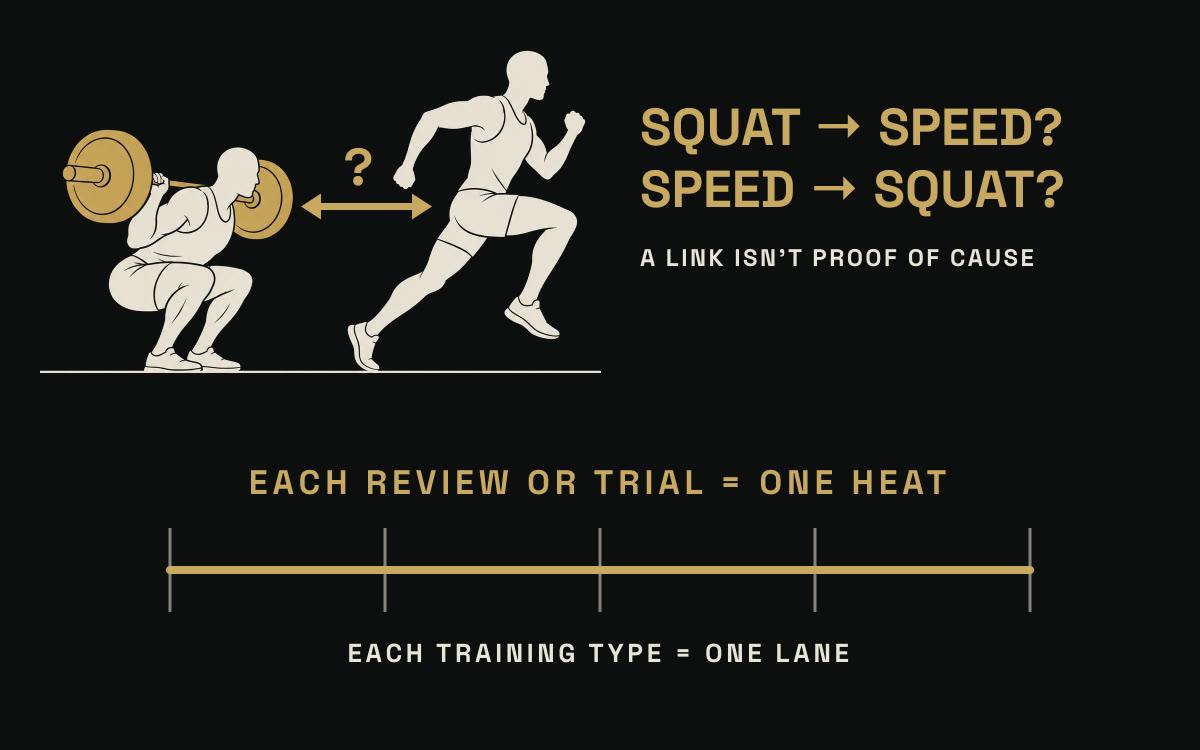
Studies that give groups different training and then time the sprint test that more directly. We lined up three reviews and one trial like heats of a race: each review or trial is one heat, and each training type in it is one lane, including a strength lane. Each heat had its own athletes, so compare lanes within a heat, not across heats.
What happened when training types were compared?
Heat 1: female team-sport players
Hughes and colleagues combined 15 studies with 362 female team-sport athletes and compared four kinds of strength training: reactive-, maximal-, combined- and special-strength. Reactive- and combined-strength training had a greater effect on sprint performance than maximal- or special-strength training. Compared with control groups doing technical and tactical training, the strength-training groups made small to moderate sprint improvements (Hughes et al., 2023). The summary gives the order of the methods, not how far apart they were, and it doesn't define reactive or combined strength training, so we keep the paper's own names.
Heat 2: top male youth soccer players
Oliver and colleagues combined 34 studies with 1,396 high-level male youth soccer players. Strength, plyometric and combined training each improved strength, jump, horizontal power and acceleration measures. Speed over 15 to 40 m improved by a small amount (g = 0.40 to 0.59), and the gains were mostly similar across the three types of training (Oliver et al., 2024).
Heat 3: Olympic lifts
Crenshaw and colleagues combined eight studies with 206 athletes (10 of them women; age range 18.9 to 24.2) and compared Olympic weightlifting with a control: no training, standard sport training, traditional resistance training or plyometrics. Over the full sprint there was no clear difference (standardized mean difference −0.07, with a margin of error, the 95% CI, from −0.47 to 0.34), and none in the acceleration phase either. The authors concluded that Olympic weightlifting does not improve sprint performance more than the comparison training (Crenshaw et al., 2024).
Heat 4: one trial in elite track athletes
Li randomly allocated 48 elite track athletes (half men, half women, aged 18 to 25) to conventional resistance training, plyometric training, integrated complex training or a control group. The programmes ran 12 weeks, three sessions a week, on top of regular sprint practice. All three training groups improved sprint performance more than the control group. The complex-training group improved sprint velocity and acceleration the most, the plyometric group improved initial acceleration the most, and the resistance-training group gained the most maximal strength (Li, 2025). It is one trial, by one author, and its summary gives no effect sizes.
| Heat | Who was studied | The strength lane | How the strength lane did |
|---|---|---|---|
| 1 · Hughes et al. (2023) | 362 female team-sport athletes, 15 studies | maximal-strength training | less sprint gain than reactive- or combined-strength training |
| 2 · Oliver et al. (2024) | 1,396 high-level male youth soccer players, 34 studies | strength training | about the same as plyometric or combined training (a small gain over 15 to 40 m) |
| 3 · Crenshaw et al. (2024) | 206 athletes, 8 studies | Olympic weightlifting | no better than no training, sport training, resistance training or plyometrics |
| 4 · Li (2025) | 48 elite track athletes, one trial | conventional resistance training | beat regular training, but less sprint gain than complex training |
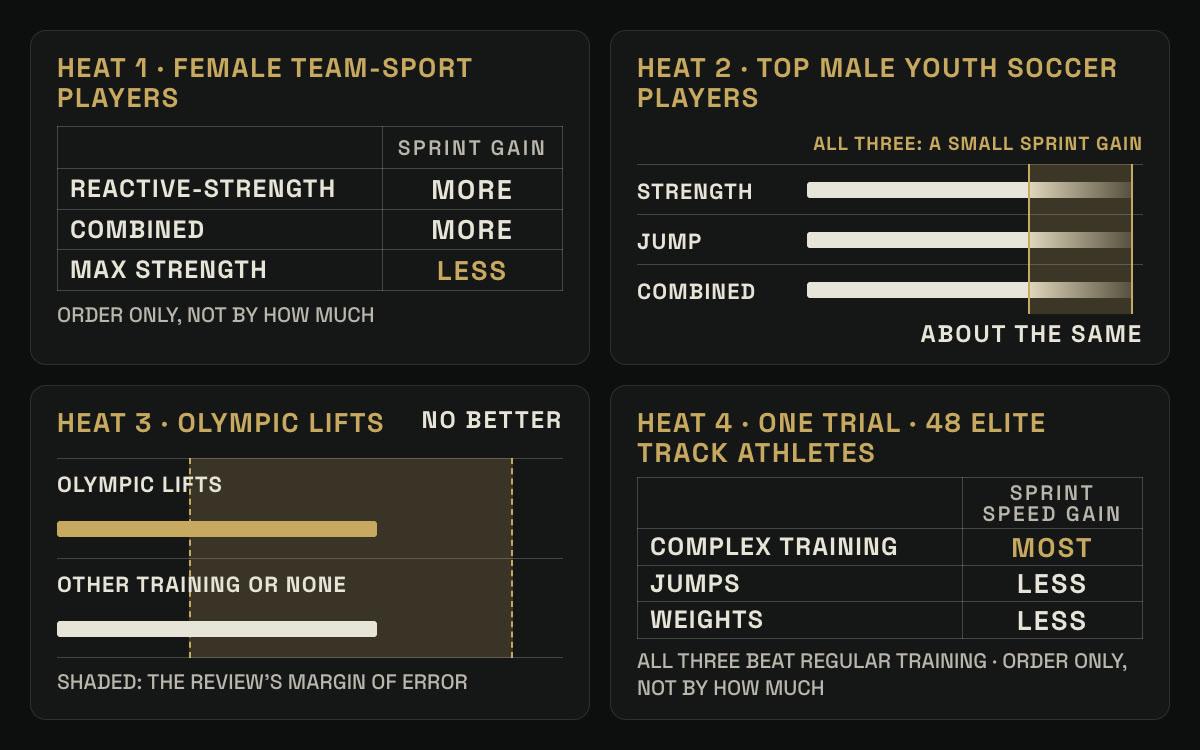
Our read: strength training can help, but it never came out ahead in a heat. In heats 1 and 4, strength groups beat groups who did only their usual training (Hughes et al., 2023; Li, 2025). In none of the four did the strength lane come out ahead.
Do the bigger reviews settle it?
No. Bigger reviews that compared many kinds of training, gym work included, point different ways. Rumpf and colleagues reviewed 48 studies with 1,485 subjects from a range of sports, comparing training over 0 to 10, 0 to 20, 0 to 30 and 31+ m. They concluded that specific sprint training seemed the most beneficial over those distances. Non-specific training (resistance and plyometric training) showed its greatest effect over 31+ m (ES −0.43, a 1.65% change), and combined training showed its greatest effect over 0 to 10 m (ES −0.59, a 2.81% change) (Rumpf et al., 2016).
Nicholson and colleagues reviewed 121 studies with 3,419 athletes from the football codes and found no single training mode to be the most effective (Nicholson et al., 2021).
On Olympic lifts, a 2022 review compared weightlifting with traditional resistance training. The average difference in sprint speed was large but too uncertain to rule out no difference (4 studies, g = 1.04, 95% CI −0.03 to 2.39), and the authors asked readers to keep in mind how much the studies differed and their risk of bias (Morris et al., 2022). They still concluded that adding weightlifting may be advantageous for athletic development. Their summary doesn't say who was studied.
With large reviews pointing different ways, we don't read any one of them as settling which training is best for sprint speed.
What don't these studies show?
- Few track athletes. Heat 4 is the only one whose summary says its athletes were track athletes, and it is one trial. Heats 1 and 2 studied team-sport and youth soccer players; heat 3's summary gives ages but not sports.
- No dose. None of these results tells you which squat load, sets or reps to use, and we don't either. Coaches still argue about it.
- Two undefined names. "Reactive-strength" and "complex" training aren't defined in the summaries we could open, so we use the papers' own names.
- A snapshot, not a test. The sprinter evidence for the link is one study of 21 men, tested for strength and speed with no training period (Requena et al., 2011).
What should you do on Monday?
Our read: nothing here says drop strength training, and nothing proves a bigger squat will show up in the sprint. So judge any lift by what it does to your sprint times. Time the same sprint before and after a few weeks with that lift: for example, 30 m in 4.20 s before and 4.12 s after (made-up numbers, to show the habit). If the sprint time doesn't move, you haven't seen that lift make the sprint faster.
Key takeaways
- Squat strength for body weight goes with sprint speed in trained sprinters; the weight on the bar alone showed no clear link over the first 20 m.
- A link isn't proof of cause. Training studies test cause.
- In three reviews and one trial with a strength lane, strength training never came out ahead.
- Strength groups still beat groups who did only their usual training in two of them.
- Our read: judge any lift by what it does to your sprint times.
Related: Training load for sprinters · What a sprint session should look like
FAQ
- Does squatting make you faster?
- It isn't proven. In trained sprinters, squatting more for body weight was linked to faster times at every distance tested (Requena et al., 2011). But in three reviews and one trial that compared training types, strength training never came out ahead (Hughes et al., 2023; Oliver et al., 2024; Crenshaw et al., 2024; Li, 2025).
- Is squat strength for body weight or the weight on the bar more related to sprint speed?
- In one study of 21 well-trained sprinters, squat strength for body weight was linked to times at all six distances tested, while the weight on the bar alone showed no significant link at 10 and 20 m (Requena et al., 2011).
- Are Olympic lifts better than squats for sprinting?
- In a review of eight studies, Olympic weightlifting did not improve sprinting more than the comparison training, which included traditional resistance training (Crenshaw et al., 2024). Another review found a large but non-significant effect on sprint speed when weightlifting was compared with traditional resistance training (Morris et al., 2022).
- Should sprinters stop lifting?
- Not on this evidence. In heats 1 and 4, strength groups beat groups who did only their usual training (Hughes et al., 2023; Li, 2025).
Figures: our own drawings; the lifter and sprinter drawings are AI-generated.