
How Far Apart Should Hard Sprint Sessions Be? Coaches' Gaps and Cut-Offs, Side by Side
Hard sprint sessions are typically kept at least 48 hours apart. A 2019 review of best practice gives 48 hours after acceleration and 48 to 72 hours after top speed or speed endurance (Haugen et al., 2019). Two things move that number for one athlete in one week: how that sprinter recovers, and how far you let the last session run.
Where the 48-hour habit comes from
The review's reason is the nervous system: intensive sprinting is treated as demanding on it, so sessions get at least 48 hours, and leading coaches rarely sprint on consecutive days (Haugen et al., 2019). Thomas et al. (2018) tested that explanation, which they say had not been well studied.
Their 10 male athletes were about 21, with more than three years of speed and strength training: six from intermittent sports and four from track and field, at university or national standard. Each did three sessions, a week apart in random order: 10 × 5 back squats at 80% of a one-rep max, 10 × 5 jump squats, and 15 × 30 m flat out with 2 minutes' rest.
An electrical pulse to the thigh nerve of a resting leg shows what the muscle can produce without the brain (the twitch). A pulse during an all-out contraction shows whether the brain is still driving the muscle fully (voluntary activation). Together they show where the fatigue sits.
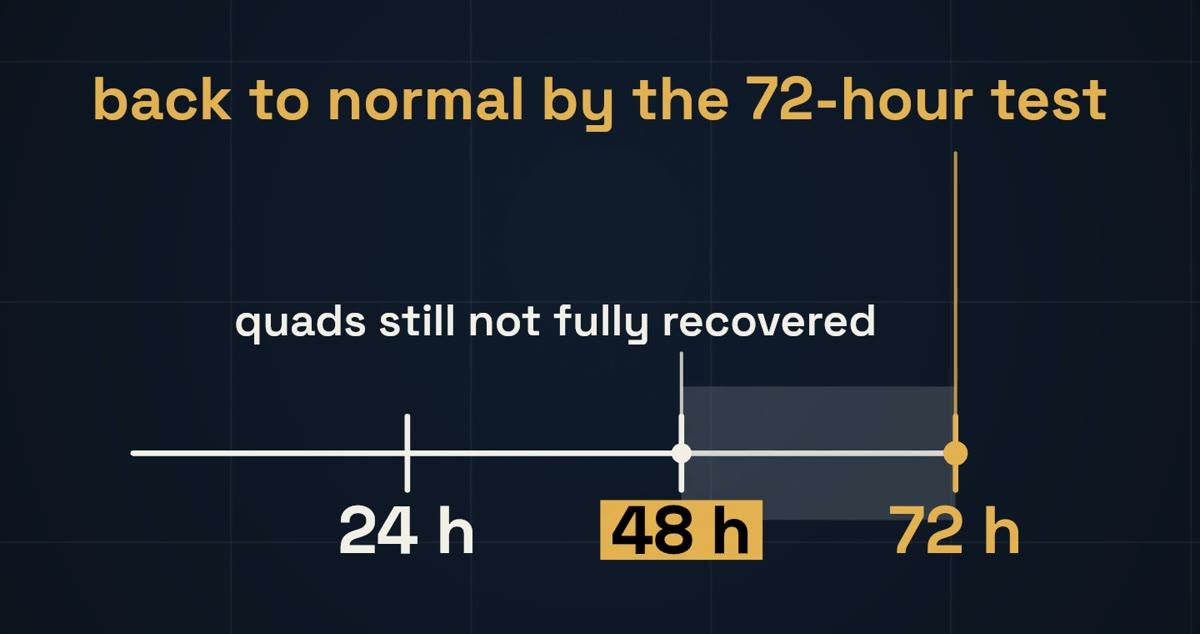
After the sprint session, voluntary activation was reduced for 24 hours, then recovered. The twitch stayed low longer: across all three sessions it was still 5 to 6% down at 48 hours, and both it and maximal force had cleared by the 72-hour test. The authors conclude the fatigue was not mainly in the nervous system, and call prioritising its recovery debatable (Thomas et al., 2018).
Two details change how a coach might use this. The heavy squats cost at least as much as the sprints: the twitch fell further straight after squats, and voluntary activation stayed down for 48 hours, not 24. Our read is that a heavy squat day is a hard day for the legs, whatever the calendar calls it.
And the session was big. Fifteen 30 m reps make 450 m on 2 minutes' rest, against 100 to 300 m and 2 to 7 minutes in the review's acceleration guideline. Average sprint time slowed from 4.40 s to 4.55 s, about 3.4% by our arithmetic. Those are group means, but on average the session ran past the 3% cut-off described below. The authors chose a high volume on purpose and question how well the results apply to normal training. A smaller session might clear sooner; no study we read tested that.
What goes in each hard session
The review's table gives distance, rest and volume. Its text adds elite and younger examples.
| Session | Reps and effort | Rest between reps | Session total | Elite example | Younger, less trained | Next hard session |
|---|---|---|---|---|---|---|
| Acceleration | 10-50 m flat out, from blocks or a crouch | 2-7 min | 100-300 m | 40 m from blocks, 7 min rest | 20 m from a crouch, 2 min rest | 48 h |
| Top speed | 10-30 m flat out, after a 20-40 m build-up | 4-15 min | 50-150 m (build-up not counted) | 40 m build-up into 30 m, about 15 min rest | 20 m build-up into 10 m, about 4 min rest | 48-72 h |
| Speed endurance | 80-150 m, above 95% of maximal velocity | 8-30 min | 300-900 m | 4-6 × 150 m, 20-30 min rest | 2-3 × 100 m, 10 min rest | 48-72 h |
The effort column is how fast a rep is meant to be, not a stop line. The review calls the last row sprint-specific endurance, and lists a separate 60 to 80 m speed endurance session at 90 to 95%, also 48 to 72 hours. Practitioners' rule of thumb for rest is 1 to 2 minutes per second of maximal sprinting, more for better sprinters (Haugen et al., 2019). This is best practice from leading coaches, mostly of 100 m sprinters, and not a trial.
The weeks coaches ran
These are what each coach did or described. None is a plan to copy.
| Whose week | Mon | Tue | Wed | Thu | Fri | Sat | Sun |
|---|---|---|---|---|---|---|---|
| Pfaff before the season, as the review describes it | Short accelerations | Maximal velocity | Sprint-specific endurance | ||||
| The review's mid-season example | Acceleration and maximal velocity | Plyometrics | Tempo | Sprint-specific endurance | Plyometrics | Tempo | Off |
| Pfaff's group, late 1990s, early specific prep (his account) | Acceleration | Recovery, technique | Speed | Recovery, technique | Acceleration | Special speed endurance or work capacity | |
| Randy Huntington's sprinter (his account) | Acceleration | Lift (power) | Track | Lift | Acceleration | Track; lift (max strength) |
Dan Pfaff, who has coached 49 Olympians, now thinks that 1990s week probably had too many training days. He had paired Friday and Saturday on purpose, to mirror championship rounds (Pfaff, 2023). Back-to-back hard days can be a deliberate choice.
In the competitive season his group moves to a three-day rollover. One example: acceleration Monday, speed Thursday, special speed endurance the next Monday, work capacity that Thursday. He says the cycle can stretch or shrink to fit the athlete.
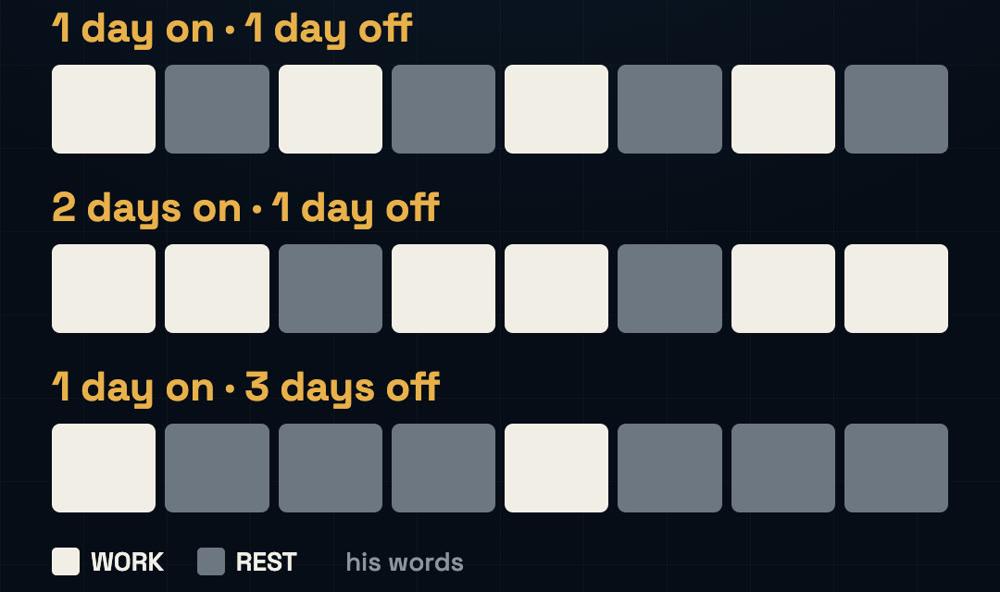
In a 2021 coaching session he described three sprinters on three patterns: a day on and a day off, two on and one off, and one day on with three off (Pfaff, 2021, from 61:37). That third sprinter spent his days off on sleep and rest, then therapy, then his own business such as sponsors. For athletes with big injury histories, Pfaff describes a hard day, complete rest, a large therapy day, then the next workout (Pfaff, 2023).
Korfist found the same extreme in a high-school sprinter whose numbers got worse on two days a week and improved every week on one: flying sprints Monday, race Friday (Korfist & Fichter, 2017). Huntington, who coached the sprinter who set the Asian 100 m record (per his podcast host), puts the rest days in first (Huntington, 2021).
When should a sprint session end?
The review's answer has no number: end when performance drops off or technique goes (Haugen et al., 2019). Coaches who time reps have put numbers on it, and they differ on the three things you need to know before borrowing one.
| Source | Drop that ends it | Counted from | Which sessions | How firm |
|---|---|---|---|---|
| Chris Korfist (Freelap, 2014) | 3% on flying 10s; 2% of the distance on 23-second runs | Flying 10s: that day's best. 23-second runs: the distance they marked | Timed flying 10s with 8 min rest; 23-second runs | One coach's practice with high-school athletes, after DB Hammer |
| Rob Assise (Track Football Consortium, 2018) | 6% in his worked example; 3-4% for speed, in his opinion | That day's best | Flying 10s, high-school group, mainly the indoor season; 1 min rest per 10 m run | His practice and opinion |
| Jake Ferry (Sportsmith, 2024) | 3% over 20 yards; 5% over 30-40 yards | Each athlete's previous best, reset at each new best | Unresisted sprints, two athletes preparing for an NFL Pro Day | In his words, anecdotal and experimental |
| Matt Tometz, after Charlie Francis (SimpliFaster, 2022) | None. 95-100% of best is a high-quality rep; under 95% he talks to the athlete first | The athlete's best | Flying 10s and 5-15 accelerations | His records, 38 mostly school-age athletes |
| Haugen et al. (2019) | No number: a drop-off or technique going | Not stated | All sprint-specific sessions | Narrative review of best practice |
We found no trial that compares these numbers, or that compares counting from today with counting from a previous best.
Korfist's version is the simplest to try. On timed, flat-out flying 10s with 8 minutes' rest, the session ends when a run is 3% slower than that day's best, so a 1.000 s best ends at anything slower than 1.030 s. That might come on the third sprint or the sixth. If athletes don't improve from one session to the next, he changes the workout (Korfist, 2014).
A cut-off can add work as well as remove it. Ferry kept two athletes on pre-set volumes for four weeks and later judged he had probably underloaded them at times. Under cut-offs, one short-sprint day produced 18 and 17 reps of 20 yards, with new bests inside the session. He says it is impossible to know how much those sessions drove their later speed (Ferry, 2024).
Tometz uses his number to open a conversation. If an athlete under 95% looked good and feels good, they run another; if readiness looks poor, he moves on to something else (Tometz, 2022).
None of these lines covers work planned below flat out. In one study, weekly 30 m flying sprints at 90 to 95% of top speed improved recreationally active adults' 10 to 30 m times, by trivial to small amounts (Skoglund et al., 2023). Tempo sits at 60 to 70% with a set volume.
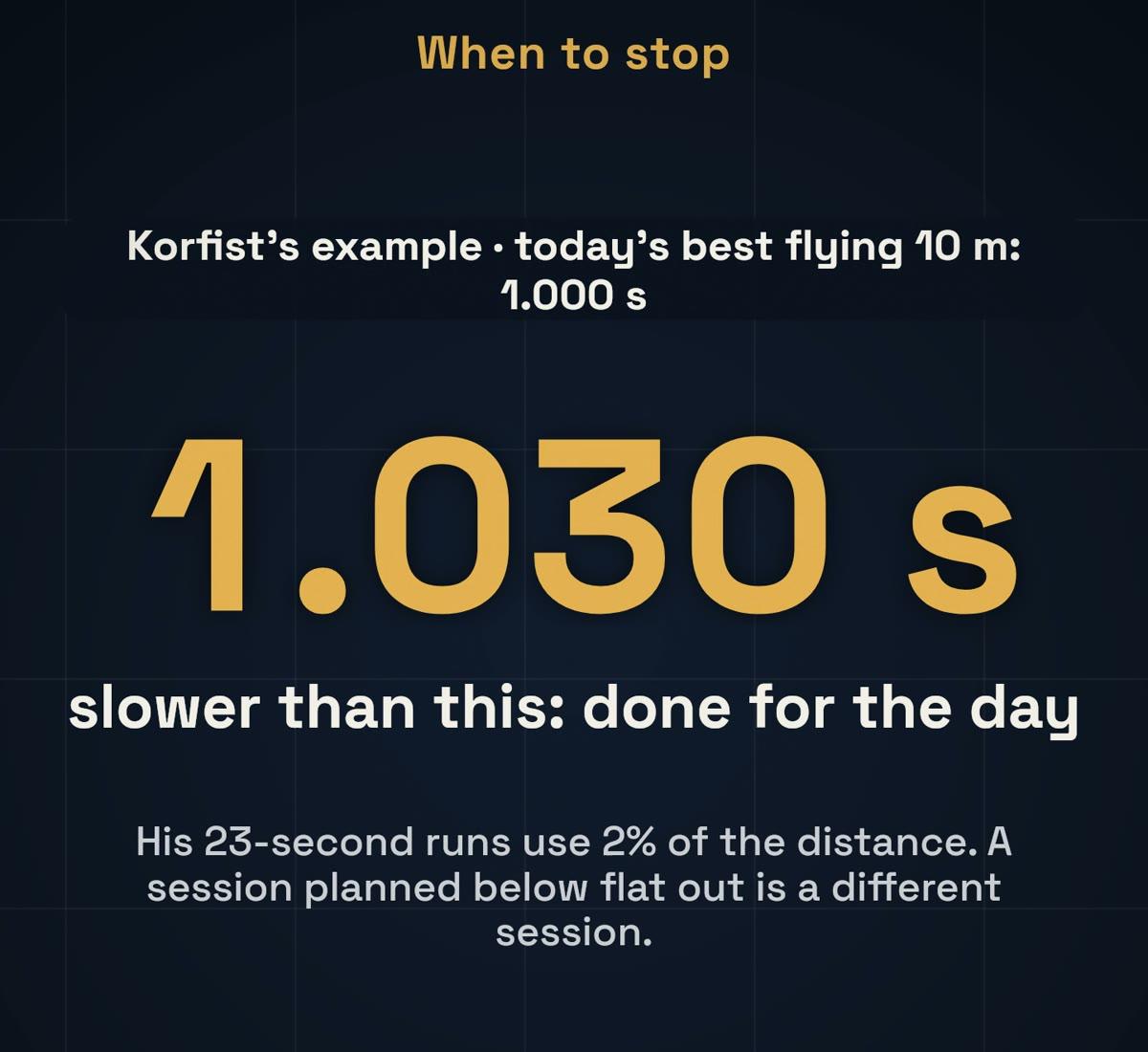
At this scale the timing matters, because 3% of 1.000 s is 0.03 s. A review of sprint timing warns against hand timing and single-beam photocells over 10 to 20 m (Haugen & Buchheit, 2016). Pfaff raises the opposite worry: he rarely told sprinters their times until after the workout, because each rep would become a race and mechanics would suffer (Pfaff, 2023). You can time every rep and keep the number to yourself.
The cut-off and the gap are one decision
Here the two questions meet. Ferry chose 3% for the short-sprint day because the next speed day came 72 hours later. The long-sprint day was the last of the week, with 96 hours before the next speed work, so he allowed 5%. Going into the Pro Days he cut that 5% to 3% (Ferry, 2024).
Korfist reports DB Hammer finding a 3-4% drop right for short sprints, ideally with 3 to 4 days before the next similar session (Korfist, 2014). Weekly meets do not allow that, so he reduced the drop-off and ran Mondays and Wednesdays, racing Friday or Saturday (Korfist & Fichter, 2017). Dan Fichter worked a jumper to 1 to 3%, depending on how many days that week they were training (Smith et al., 2026).
If the calendar forces a short gap, try a smaller drop. If you can give three or four days, the last session can run further. That is these coaches' reasoning; we found no trial testing it.
How to tell when a sprinter needs 72 hours
Try three quick checks at the start of the next hard day.
Ask how the legs feel from 1 to 10, against that athlete's usual score. In a systematic review, self-reports tracked training load better than blood and heart-rate measures, and the two generally did not correlate (Saw et al., 2016).
Jump a few times and compare the average height with the athlete's fresh-day normal. A meta-analysis found the average more sensitive than the single best jump (Claudino et al., 2017). Stay on one device: a force plate, a contact mat and a phone app were each reliable, but their absolute values differed (Bagchi et al., 2024). Ignore small dips. In youth soccer players, jump height had to change by 8.55% before the change could be told from noise (Badby et al., 2026). Across force-plate studies, jumps were down on days 1 and 2 after hard exercise and back by day 3 (Williams et al., 2025), the same window as the quadriceps study.
Time today's first flying 30 m on timing gates against recent first reps. We found no study or coach using this exact comparison, so read a clear slowdown as a prompt.
Log all three on a few fresh days first, with the same tools. If two of the three keep coming up short, week after week, try 72 hours between hard days instead of 48. For a group, try keeping the hard days and giving 72 hours to whoever keeps coming up short. For an athlete back from a layoff, these sources give no baseline.
What two coaches did in race week
Two examples, with one principle over them: nothing new in race week, only what the athlete has trained all year.
With Friday-night meets in the 1990s, Pfaff's athletes might run blocks Monday, speed Tuesday or Wednesday, a pre-meet Thursday, and leave the long runs for the next week (Pfaff, 2023).
Charlie Francis's 10-day taper, printed in the review, is for the year's biggest competition and assumes the previous 6 to 8 weeks went to plan.
| Days before | What he prescribed |
|---|---|
| 10 | Spikes: 4 × 30 m from blocks; flying 80, 100, 120, 150 m at maximal intensity, 20-35 min between |
| 9 | Grass: 10 × 200 m tempo |
| 8 | Spikes: 4 × 30 m from blocks + 120 m at 95% |
| 7 | Grass: 2 × 10 × 100 m tempo |
| 6 | Spikes: 4 × 30 m from blocks + 150 m at 95% |
| 5 | No training |
| 4 | Spikes: 4 × 30 m from blocks + 80 m at 95% |
| 3 | Grass: 10 × 100 m tempo |
| 2 | Spikes: 4 × 30 m from blocks at 95% |
| 1 | No training |
Spike days fall 10, 8, 6, 4 and 2 days out, each 48 hours from the next (our arithmetic), so even the taper keeps the gap.
What the research cannot settle
The review says no direct evidence compares outcomes across these approaches, and most sprint studies use young team-sport athletes (Haugen et al., 2019). The only weekly-frequency trial we found gave 36 young male soccer players one or two equal-volume sessions a week for ten weeks, and linear sprinting did not differ (Marzouki et al., 2021).
What coaches can do with this
These are coaches' practices and one small study, so adapt them.
- Try the review's gaps first, then stretch or shrink them to the sprinter, as Pfaff describes.
- Count a heavy squat session as a hard day for the legs when you space the week (our read of the squat results above).
- On timed, flat-out flying 10s, try Korfist's line: 8 minutes' rest, ending at 3% slower than that day's best.
- If the gap to the next hard day is short, try a smaller drop, as Ferry and Korfist did.
More on the session itself: what a sprint session should look like and training load for sprinters.
FAQ
- Does a tempo day count as a hard day?
- The review lists tempo at 60 to 70% with 24 hours to the next hard session. Huntington counts tempo as work, even when it helps recovery.
- Does the 3% apply to every sprint session?
- Korfist gives it for timed flying 10s and uses 2% of the distance on his 23-second runs. Other sessions have other numbers or none.
Figures: our own cards from this topic's reel and carousel, drawn from Thomas et al. (2018), Pfaff (2021) and Korfist (2014).