
What Is the A-Skip For? Four Reasons, and a Cue to Try for Each
Pick the A-skip for one reason, then give the athlete one cue and watch for one thing. For rhythm, try legs and arms rising at the same pace. For waking up the nervous system and stiff foot contacts, try a really stiff ankle and listen for a quick pop. For top speed, try driving the thigh down from high. Whether the A-skip helps the start is still open: we found no study that tested it.
Do drills make you faster?
People say drills don't make you faster. Tony Holler still uses them. He is the coach behind Feed the Cats, as the host introduces him on the Just Fly Performance Podcast, episode 464. It is a speed program that, as he describes it in episode 336, at 37:32, has plenty of rest and recovery and builds its hard work on speed and explosiveness. In episode 464, at 68:26, he gives two reasons for his speed drills: they give him a chance to coach, and his athletes warm up in them so they don't get hurt sprinting.
The research gives no clean answer either way. We found no trial that trained the A-skip for weeks and then timed the sprint. In one study of 63 young men with no athletics background, a technique score for the A-skip had a trivial link with 5 m and 20 m sprint times, and it was not statistically significant; the B-skip score predicted both distances best (Matijašević et al., 2025). That study tested everyone at one time point, so it says how A-skip skill and sprint times go together, not what training the A-skip does.
Coaches pick it anyway. 209 Irish-based track and field coaches answered a survey on drills (Whelan, Kenny & Harrison, 2016). According to the PhD thesis that reports the survey in full (not peer-reviewed), the A-skip was the most popular drill, and the coaches chose their drills mainly on what other coaches were doing, not on scientific evidence. They said drills matter for technique, strength, balance and warm-up, and should mimic sprinting (Whelan, 2017).
So pick the A-skip for a reason, and give the athlete one thing to focus on. Here are four reasons you might pick it, each with a cue to try and one thing to watch for.
The four reasons at a glance
| Reason | Cue to try | Watch for | Where it comes from |
|---|---|---|---|
| Rhythm | Legs and arms rising at the same pace | Arms and legs on one beat | Noah Lyles's drill tutorial |
| Wake up the nervous system, practise stiff contacts | A really stiff ankle | A quick pop at each contact; if the foot sits, cue the ankle again | Stu McMillan's warm-up |
| Top speed | Drive the thigh down from high | The same drive when the athlete skips into a run | Whelan (2017), a PhD thesis; Jonas Dodoo |
| The start | The same cue | On film, step 1: the foot lands behind the hips | Nagahara et al. (2014); King et al. (2022) |
Rhythm: legs and arms on the same beat
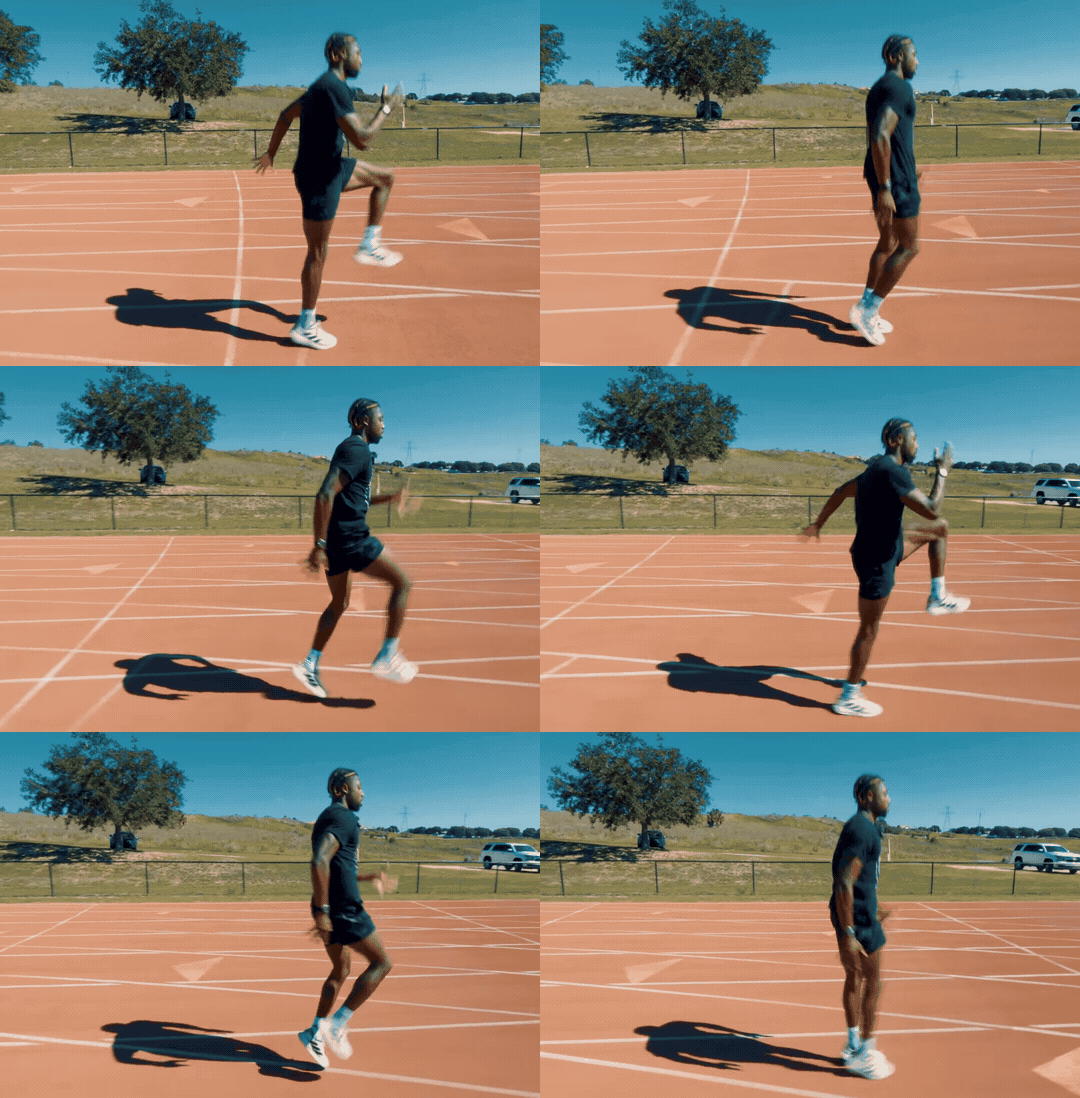
For rhythm, try Noah Lyles's cue. Lyles, the 2024 Olympic 100 m champion, teaches the A-skip in his own YouTube drill tutorial with the legs and arms rising at the same pace (at 1:31).
Watch for arms and legs on the same beat. Rhythm is one of the reasons coaches give for A-skips, alongside technique (Matijašević et al., 2025).
Waking up the nervous system: listen for the pop
To wake up the nervous system and practise stiffness at foot contact, try Stu McMillan's warm-up: skips in place of a jog, with one cue. McMillan is the CEO of ALTIS and, as Andrew Huberman introduces him, has coached more than 70 Olympians. In a Huberman Lab clip, he says his athletes typically warm up by skipping and striding (0:44), and that a skip carries stiffness at the ankle, the knee and the hip (0:55). Before a sprint practice, he would rather have athletes skip and walk in turn than jog (5:25). He talks about skipping in general, not the A-skip by name.
His cue is a really stiff ankle (3:39), and he points out that you may hear the pop of his feet (3:48). So listen for a quick pop at each contact. If the foot sits on the ground instead, cue the ankle again. Don't make a flat foot the failing sign: in the same clip, McMillan cues a flat-footed landing (4:03).
Jonas Dodoo, head coach and founder of Speedworks Training, makes a similar point on the Pacey Performance Podcast (23 February 2023, at 34:12): he builds the foot contacts athletes need for quick force and ankle stiffness through running drills, alongside plyometrics. We cover the different kinds of stiffness in stiffness training in four layers.
Sprint coaches name this kind of goal for a warm-up. In a survey of 31 Brazilian coaches of national and international sprinters, warm-up goals included neuromuscular ones such as motor unit recruitment, next to muscle temperature and blood flow, and warm-ups typically included sprint-specific drills (Loturco et al., 2026).
We found no study that tested A-skips as a warm-up for the next sprint. The closest test used a different drill. In 10 male college sprinters, three fast runs over 10 mini-hurdles (22 cm high, 90 cm apart) raised top speed by 3.2% and step frequency by 3.3% on the sprint after it; three 60 m bounding runs, 3 minutes apart, did not (Yoshimoto et al., 2016).
The only peer-reviewed measurements of A-skip forces and moments we found were in distance runners, not sprinters. In 14 trained distance runners, calf peak force and power were lower in the A-skip than in running (Trowell et al., 2022). In 17 long-distance runners, ankle, midfoot and toe-joint moments in five drills, the A-skip among them, did not differ from those of a run at 3.88 m/s (Abran et al., 2025).
And keep it short. Holler's speed drills are ten drills of about five seconds each, about 50 seconds of work in all, followed by three short sprints (episode 464, at 77:20).
Top speed: coach the hip, not the knee
If the A-skip is there for top speed, coach the part of it that matches top speed. One PhD thesis compared the A-skip with maximal sprinting in 15 sprinters (8 men, 7 women), national finalists up to international level, with the sprint stride taken 40 m into the run, where they were to be at top speed (Whelan, 2017). It is a University of Limerick thesis, not a peer-reviewed paper. We use it because we found no peer-reviewed study of A-skip joint angles in sprinters.
The hip action was closer: 12 degrees apart, against a pooled variation of 8.0 degrees. The knee was far off: 35.5 degrees apart, about seven times its pooled variation. For the first 40% of the A-skip cycle, the knee stayed extended and nearly straight, which the author reads as a longer ground contact than in sprinting, and the ankle angle stayed between 117 and 125 degrees (Whelan, 2017). An older master's thesis points the same way: in 8 university-level sprinters, ground contacts were longer in the A and B drills than in sprinting (Kivi, 1997, as summarised by Whelan, 2017).
On our own clips of Noah Lyles, the knee goes the same way. Measured from 2D video and good to a few degrees, his knee at mid-stance sits at about 170 degrees in the A-skip and about 155 degrees at top speed. His knee stays straighter on the ground in the drill.
Jonas Dodoo picks skips for the hip. In his Max Velocity webinar (at 8:15), he says that for what he calls thigh block, getting the hip fully extended from a fully bent position, his usual drills are a skip and its variations.
So try one cue: drive the thigh down from high. Then have the athlete skip straight into a run, and watch for the same drive at speed. Filming the run-out from the side lets you check it frame by frame.
The start: a little similar, and an open question
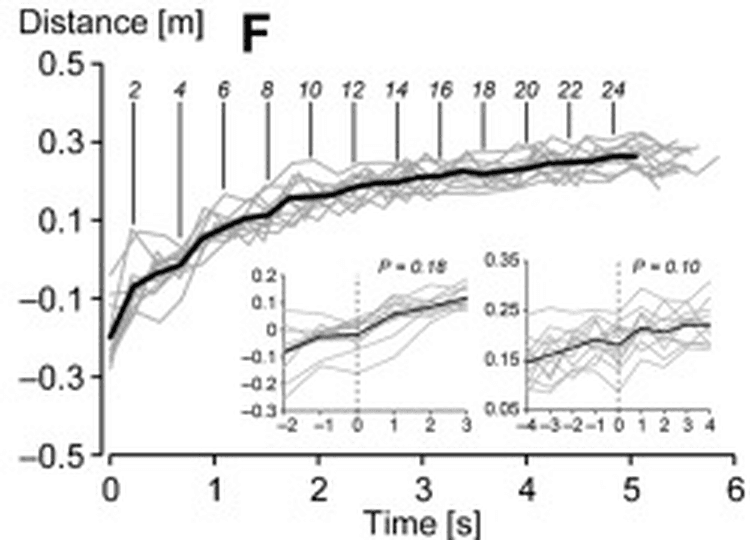
For the start, the A-skip is a little similar: the first steps drive the thigh down quickly too. In one study, 12 male sprinters (100 m and 200 m specialists) ran a 60 m sprint in front of 60 infrared cameras. Until the first transition, at about step 4.4, their feet touched down behind the centre of gravity with a rapid rise in hip extension speed, and they accelerated step to step with a pushing motion (Nagahara et al., 2014).
Where the foot lands is the difference. In that study, the foot landed behind the centre of gravity for the first four steps, and in front of it from the fifth (Nagahara et al., 2014). The A-skip is taught to put it under the body. Lyles teaches that the legs come down directly under the hips, not behind and not in front (1:46), and one research team's A-skip scoring sheet grades a forefoot landing close under the body (Matijašević et al., 2025).
Does that landing matter? In another study of 14 male sprinters, over the first four steps of two maximal 60 m sprints from a block start, a foot further behind the centre of mass at touchdown went with a greater ratio of forces, meaning a more forward push, and so did a more forward-leaning shin (King et al., 2022). That is a link, not proof of cause, and the sprinters' training level is not reported in the abstract.
Even drills built for the start may not push forward like one. Six regional- and national-level sprinters and hurdlers did 14 start exercises, chosen by the coaches the authors interviewed as typical of training, on six force plates set into the track. None produced more horizontal force or speed than an all-out sprint acceleration, and the authors read the exercises as training vertical rather than horizontal force, against what the coaches had expected (Jusseaume et al., 2025). The A-skip was not one of the 14.
So does the A-skip help the start? We found no study that tested it: no training trial that timed sprints, no test of A-skips before a sprint, and no study comparing the A-skip with the first steps of a start. None of the 57 coach talks we have indexed links the A-skip to acceleration or block starts either.
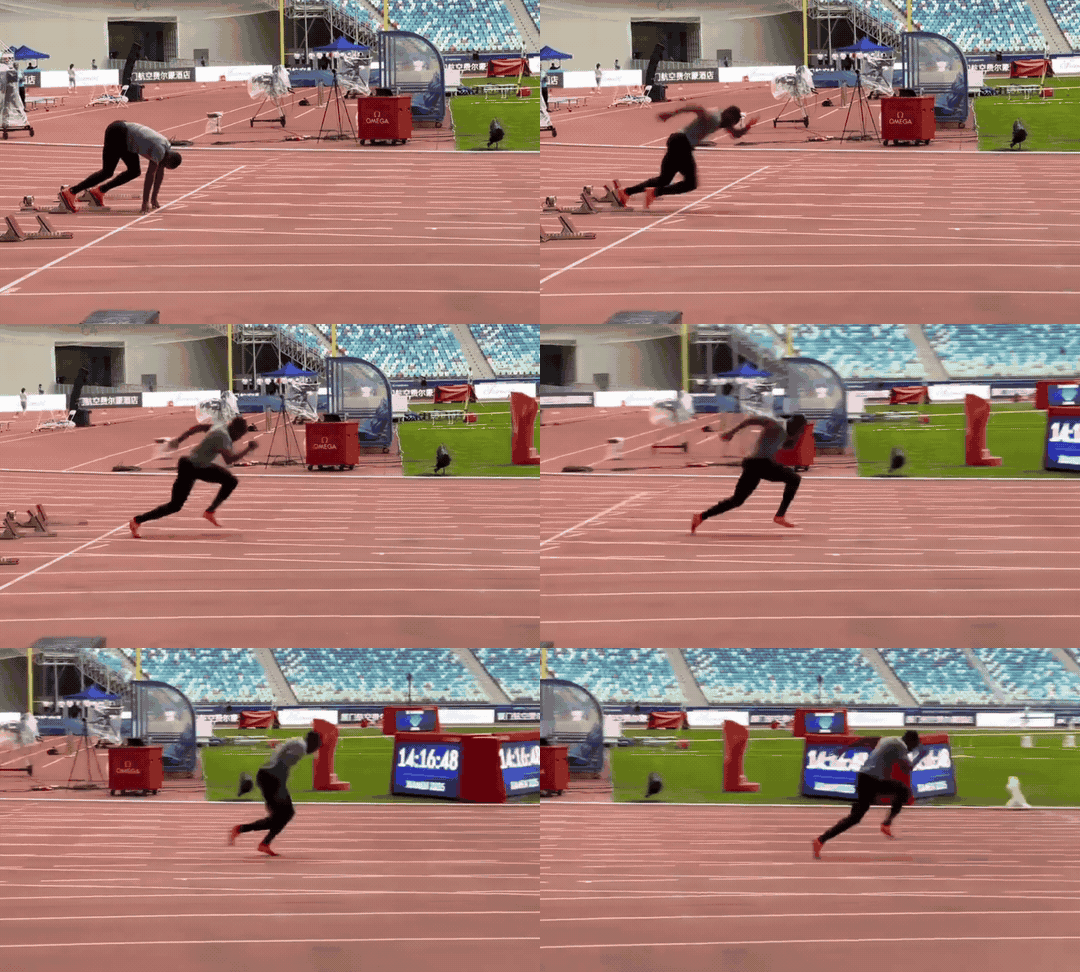
If the start is your reason, try the same cue, and film the first step from the side. Check whether the foot lands behind the hips; on video, the hips stand in for the centre of mass the studies measured. The four steps were a group average. In the one elite start we measured frame by frame, Christian Coleman's, from a training video, only the first step landed clearly behind the hip line.
What we couldn't find
These come from our PubMed searches and our coach-talk index in November 2026. They are not a systematic review.
- A trial that trained the A-skip for weeks and then timed the sprint. So there is no tested A-skip dose either: no sets, reps or progression.
- A test of A-skips as a warm-up for the next sprint. The closest is the mini-hurdle study above.
- A study comparing the A-skip with the first steps of a start.
Key takeaways
- Pick the A-skip for one reason, give one cue, and watch for one thing.
- Rhythm: legs and arms rising at the same pace (Lyles's cue). Watch for one beat.
- Waking up and stiff contacts: a really stiff ankle (McMillan's cue). Listen for a quick pop; if the foot sits, cue the ankle again.
- Top speed: in one PhD thesis, the A-skip's hip action was much closer to sprinting than its knee. Try driving the thigh down from high.
- The start: in one study, the foot landed behind the body for the first four steps, while the A-skip is taught to land it under. We found no study that tested whether the A-skip helps the start.
FAQ
- Does the A-skip make you faster?
- We found no trial that trained the A-skip for weeks and then timed the sprint. In 63 young men with no athletics background, A-skip technique scores had a trivial, non-significant link with 5 m and 20 m times (Matijašević et al., 2025).
- Should the A-skip land on the forefoot or flat?
- Sources differ. One research team's scoring sheet grades a forefoot landing close under the body (Matijašević et al., 2025). Stu McMillan cues a flat-footed landing in his skips and listens for the pop. Whichever you cue, if the foot sits on the ground, try cueing a stiffer ankle.
- How long should drills take in a warm-up?
- Tony Holler's speed drills are ten drills of about five seconds each, about 50 seconds of work, then three short sprints. That is one coach's dose; we found no tested A-skip dose.
- Is the A-skip a block-start drill?
- It is a little similar, since the first steps drive the thigh down quickly too. But the A-skip is taught to land the foot under the body, while in one study the foot landed behind it for the first four steps of a sprint (Nagahara et al., 2014). We found no study that tested whether the A-skip helps the start.
- Why cite a PhD thesis?
- We found no peer-reviewed study of A-skip joint angles in sprinters. Whelan (2017) is a University of Limerick PhD thesis, not a peer-reviewed paper, and we label it that way every time.
Figures: Noah Lyles's A-skip from his YouTube drill tutorial; Christian Coleman's start from a training video on the Sprint Technique YouTube channel; Figure 4F from Nagahara et al. (2014), Biology Open, CC BY 3.0, cropped from the original figure.