
Stiffness Training for Sprinters: Four Layers and What Adult Tendon Studies Show
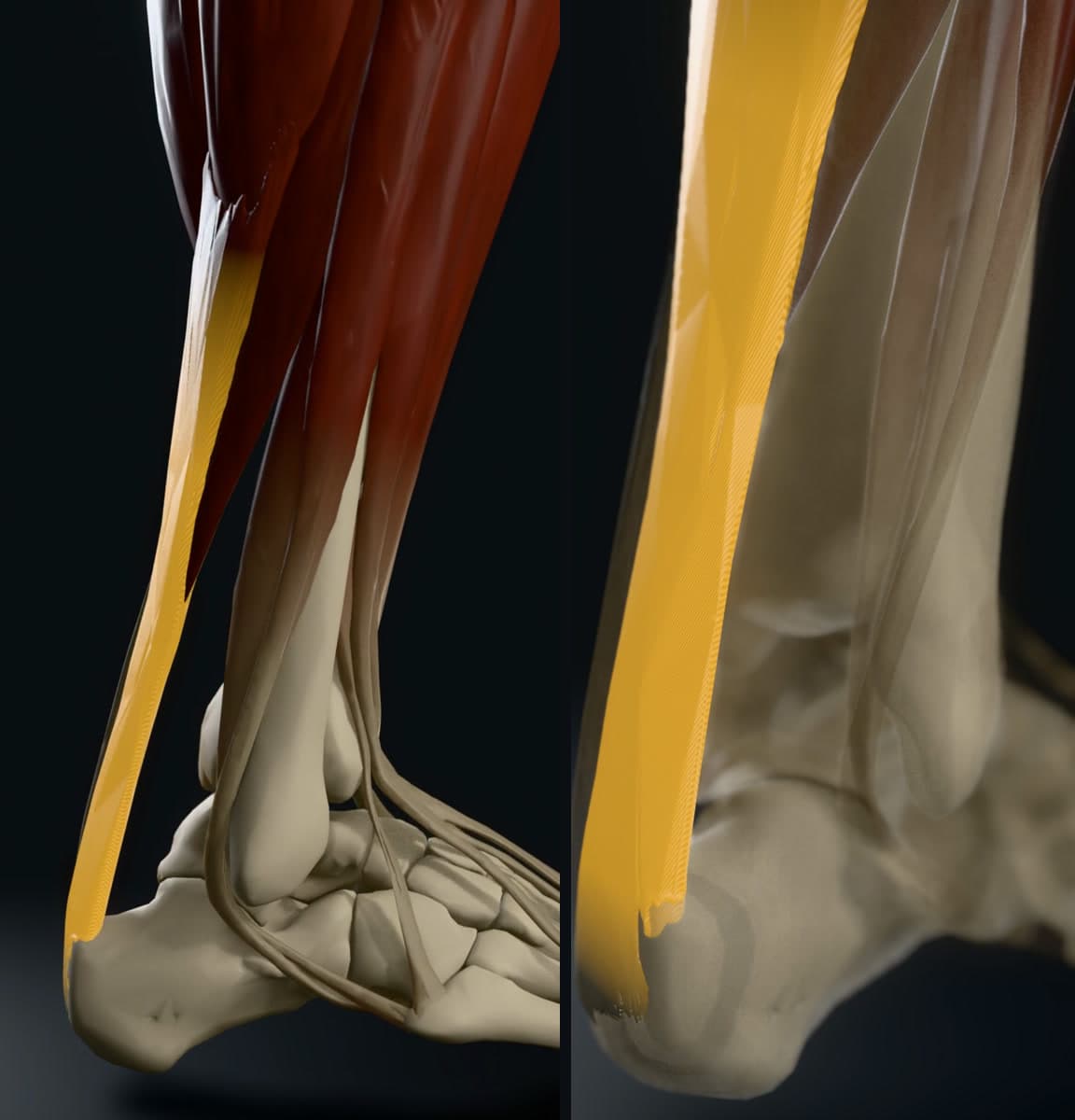
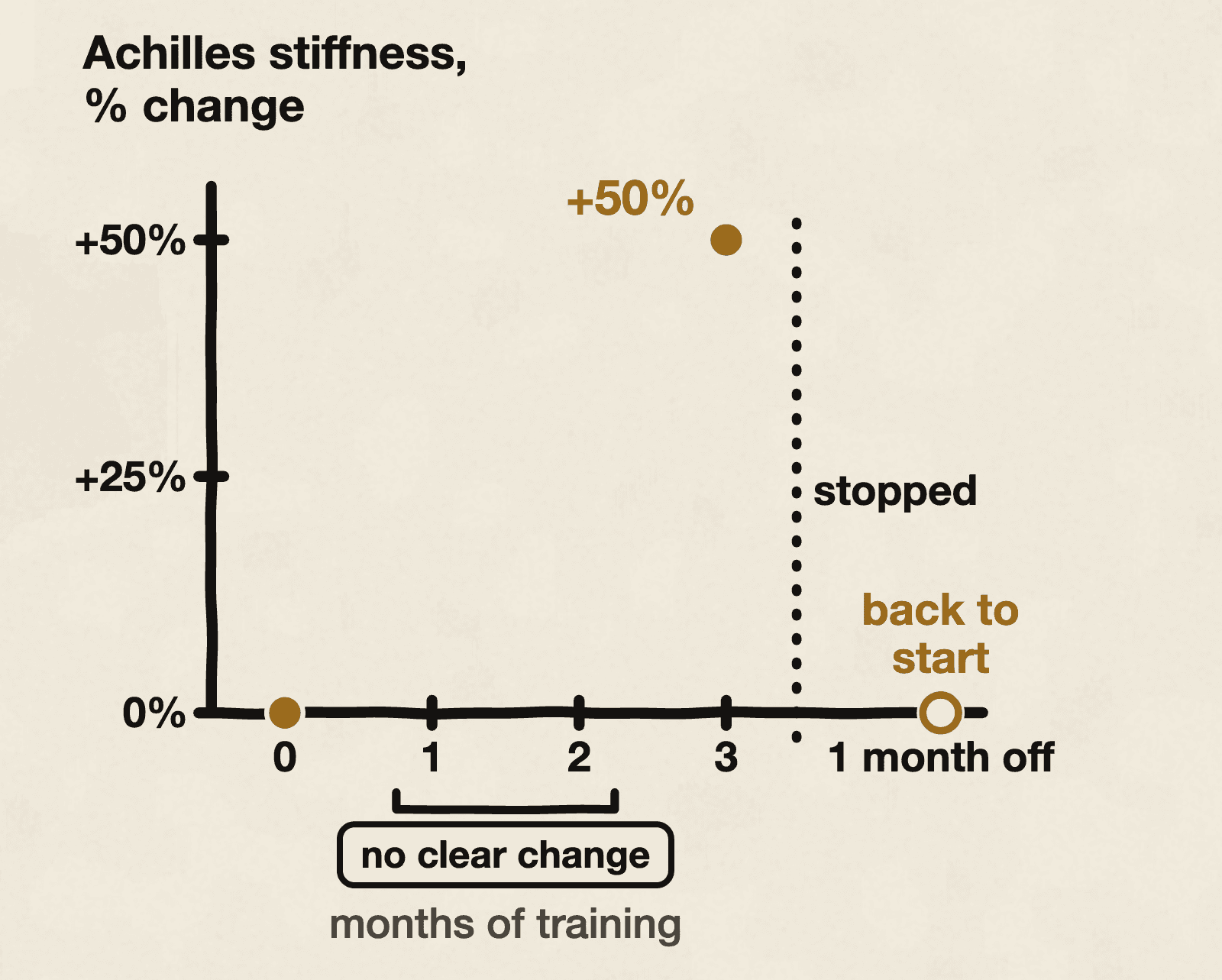
Three months of heavy calf pushes made the Achilles tendons of nine regularly active men aged 21 to 27 about 50% stiffer. After one month off training, all of that extra stiffness was gone (Kubo et al., 2012). The tendon is only one of four layers of stiffness. In another study, of 10 untrained men, heavy calf raises stiffened the tendon, with no clear change at the ankle; hops and drop jumps stiffened the ankle, with no clear tendon change (Kubo et al., 2007).
What is stiffness?
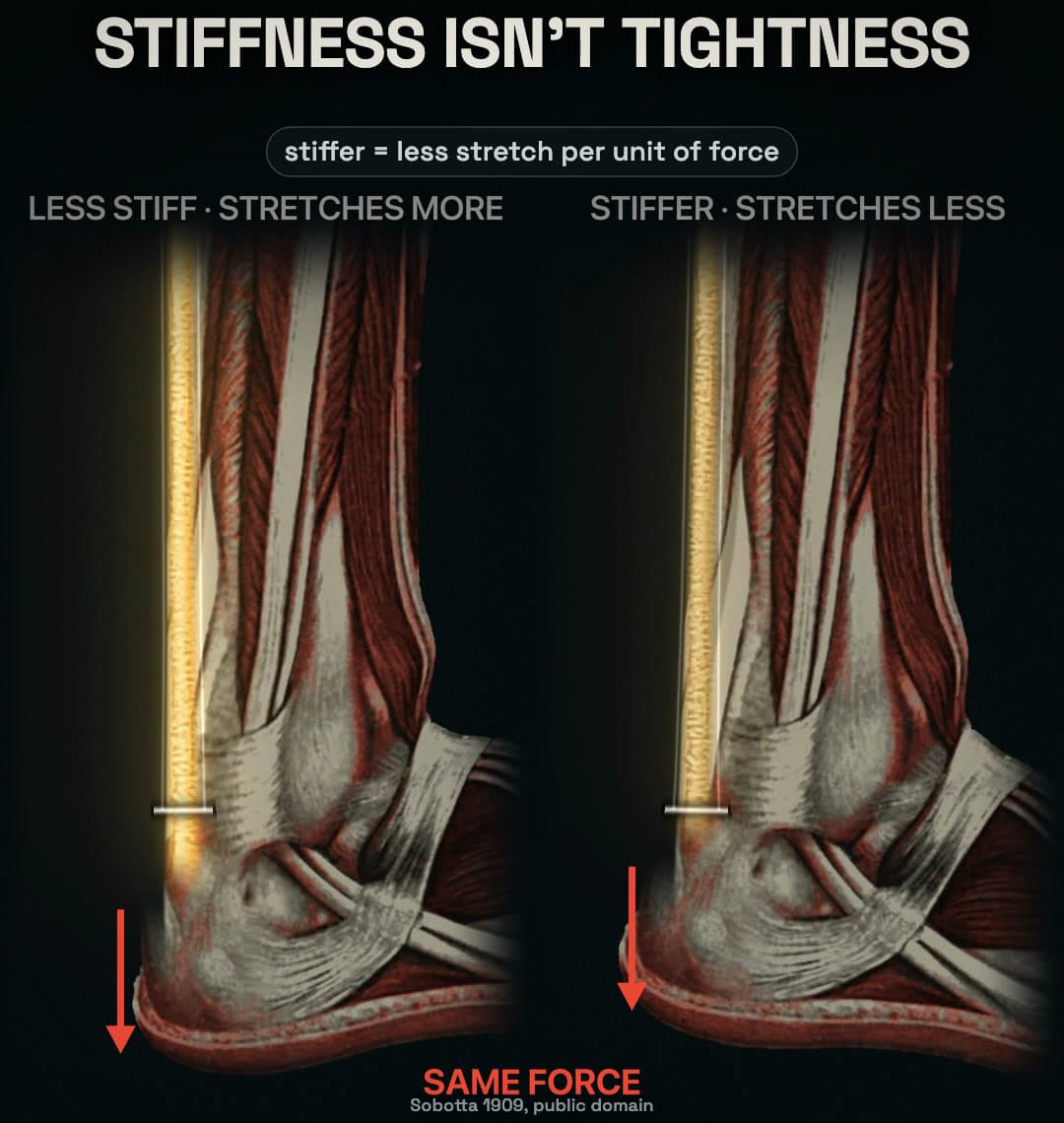
Stiffness is how little something gives under a force. Formally, it is the force it takes to stretch or compress a spring by a given amount (Brughelli & Cronin, 2008).
Tendon stiffness isn't tightness. A stiffer tendon just stretches less under the same force (Arampatzis et al., 2007). In 11 untrained men, isometric calf pushes raised tendon stiffness while passive muscle stiffness showed no clear change (Kubo et al., 2017). In healthy tendons, increased stiffness can be an adaptation to load (Bohm et al., 2015).
What are the four layers?
The tendon is only one of four layers of stiffness. The other three are how little your ankle bends, your leg squashes and your body sinks when you land. Biomechanists measure stiffness at the joint, the leg and the whole body (Maloney & Fletcher, 2021); add the tendon and you have the four layers.
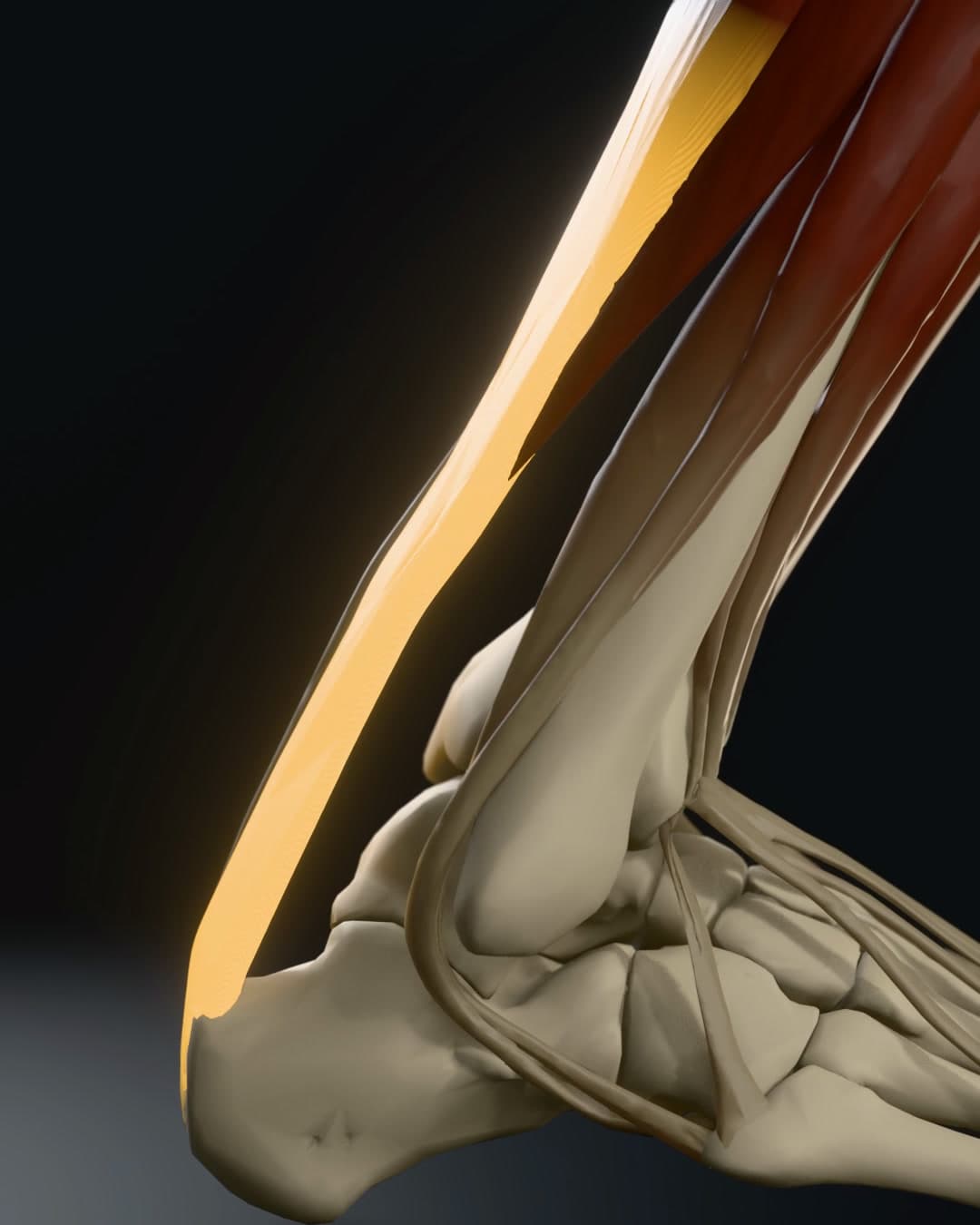
Tendon: stretch per force. When you run, the Achilles tendon does most of the stretch and snap-back, and the calf muscle above it moves much less. In adults walking and running at up to 5 m/s, soleus fibres supplied only 20% of the calf muscle-tendon unit's shortening speed, and the tendon supplied the rest (Lai et al., 2015). A computer model of running puts tendon recoil's share of the soleus muscle-tendon unit's positive work at 53% when jogging and 74% when sprinting (Lai et al., 2014).
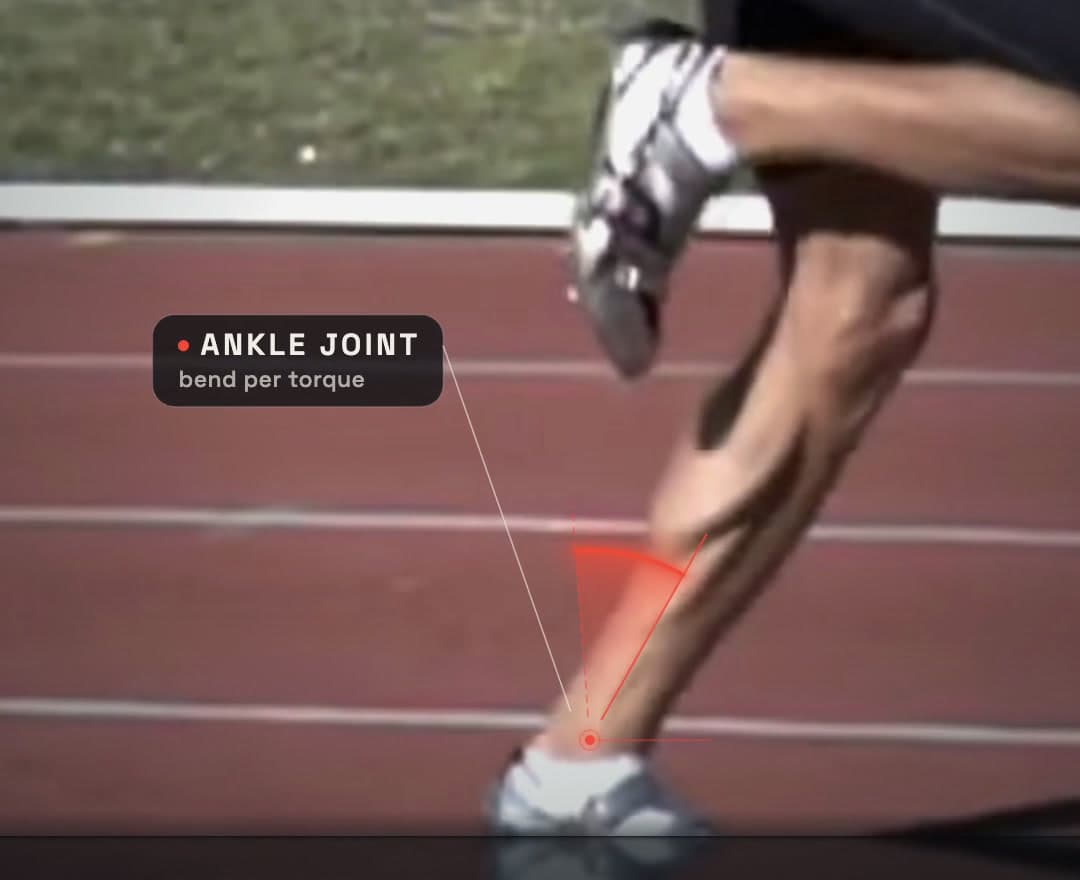
Ankle joint: bend per torque. Joint stiffness is the torque it takes per degree the joint bends (Kuitunen et al., 2002). At the ankle, that is how little the ankle gives when you land.
Whole leg: squash per force. Leg stiffness is ground force divided by how much the leg shortens, hip to foot, when you land (Brughelli & Cronin, 2008; Maloney & Fletcher, 2021).
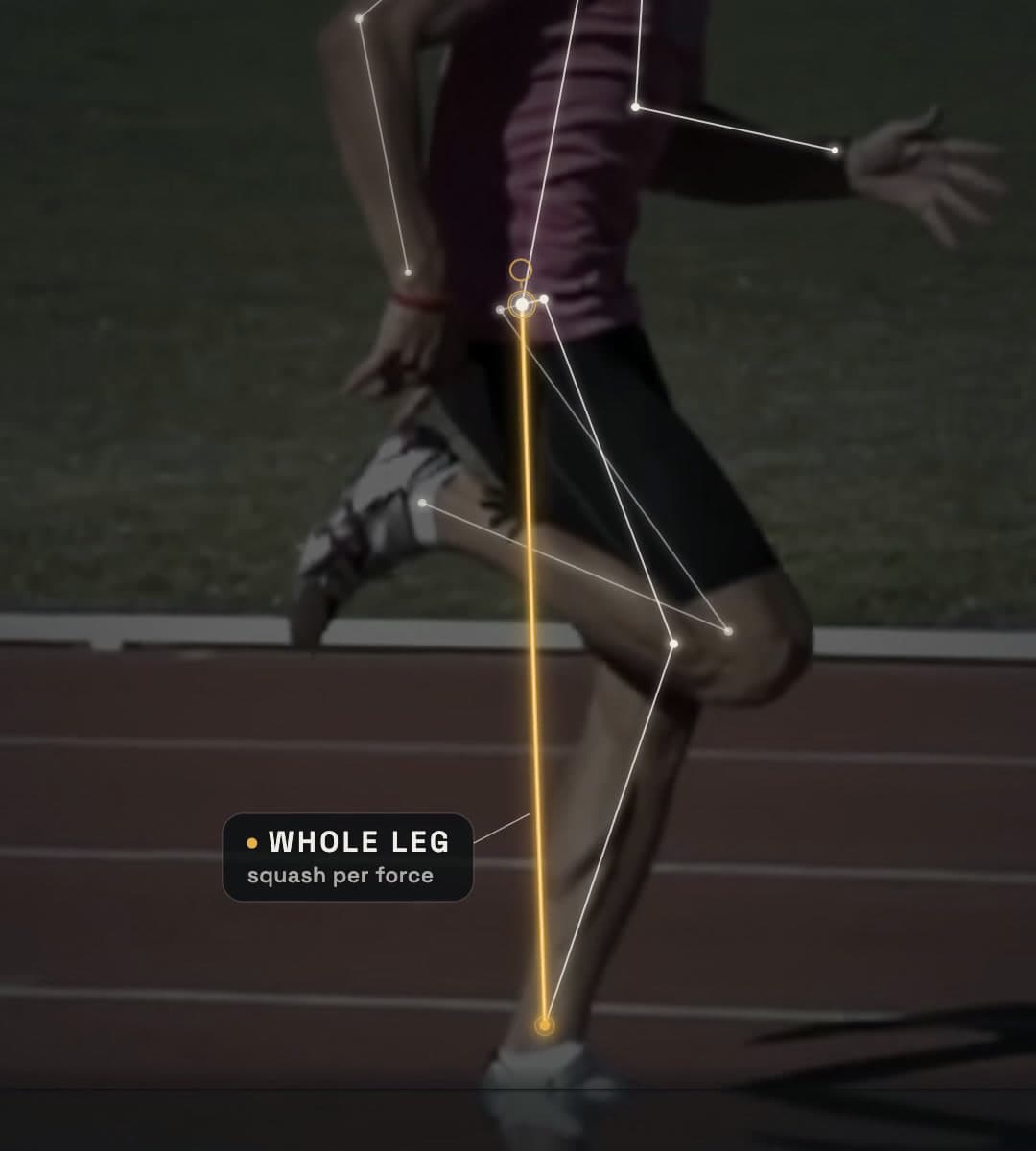
Whole body: sink per force when you land. Whole-body stiffness is how little your body's centre sinks during each ground contact, for how hard you hit the ground: peak vertical ground force divided by how far the centre of mass drops (Hobara et al., 2019).
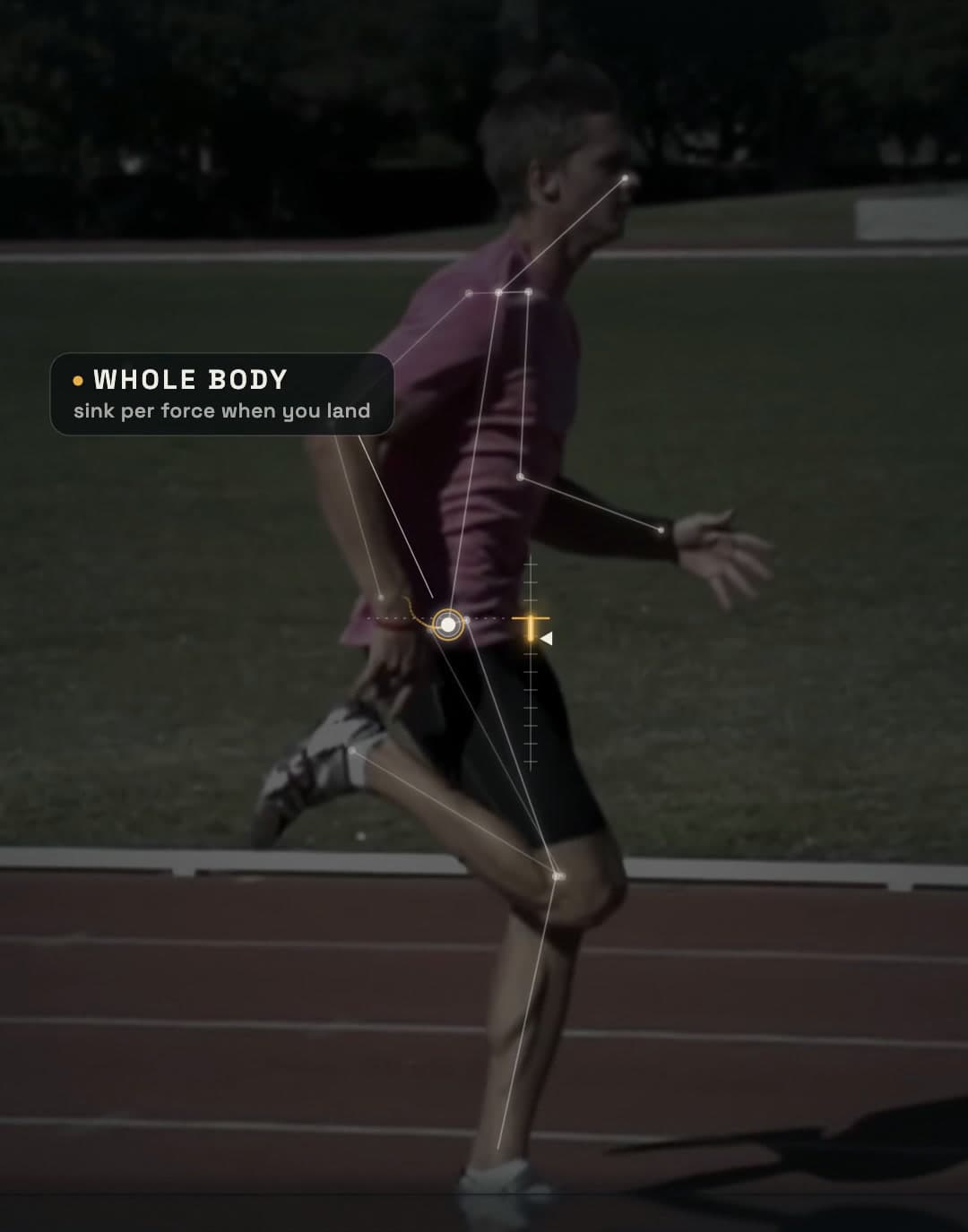
Whole leg and whole body sound alike, but they are different numbers. Leg stiffness is measured along the leg, hip to foot; whole-body stiffness is measured at your body's centre. The two numbers can move apart: in runners going from slow to moderate speeds, whole-body stiffness rose while leg stiffness stayed constant (Brughelli & Cronin, 2008).
The layers are linked. In hopping, leg stiffness is set mainly by ankle stiffness (Farley & Morgenroth, 1999), and in sprinters, ankle stiffness may depend on tendon stiffness (Kuitunen et al., 2002). Linked layers can still answer to different training, as the next study shows.
Do the four layers train differently?
Yes. In one study, the same people trained two ways, and each kind of training moved a different layer. Ten untrained men trained one calf with heavy calf raises and the other with hops and drop jumps, four days a week for 12 weeks. Heavy calf raises stiffened the tendon, with no clear change at the ankle; hops and drop jumps stiffened the ankle, with no clear change at the tendon (Kubo et al., 2007). A second study by the same first author agreed on the tendon: in 11 untrained men, hops and drop jumps brought no clear change in tendon stiffness, while isometric calf pushes raised it (Kubo et al., 2017).
| Same 10 untrained men, one calf each way | Heavy calf raises (80% of 1RM) | Hops and drop jumps (40% of 1RM) |
|---|---|---|
| Tendon stiffness | rose | no clear change |
| Ankle-joint stiffness | no clear change | rose |
Our read: a plyometric block on its own may leave the tendon where it was, and calf raises on their own may leave the ankle where it was. That is why each layer below gets its own exercise.
How fast does the tendon build and lose stiffness?
Tendon stiffness builds over weeks to months. In two small studies that measured it every month, the extra stiffness was gone one to two months after training stopped.
Achilles (Kubo et al., 2012). Nine regularly active men aged 21 to 27 did heavy isometric calf pushes four days a week for three months: 15 pushes of 15 s at 80% of their max push per session (dose as reported by Kubo et al., 2017). Achilles stiffness showed no clear change at months one and two, then was 50.3% higher at month three. One month after they stopped training, all of that extra stiffness was gone: the tendon was back to its starting stiffness.
Knee (Kubo et al., 2010). In a study on knee training, tendon stiffness faded faster than strength. Eight regularly active men did isometric knee-extension pushes for three months, then took three months off. Strength held through the three months off, but the kneecap tendon's extra stiffness was gone within two months.
| Knee study, 8 regularly active men | Month 2 of training | Month 3 of training | 3 months off |
|---|---|---|---|
| Strength | +29.6% | +40.5% | held (no clear change) |
| Kneecap-tendon stiffness | no clear change | rose | back to its starting level by month 2 off |
So a month or two into time off, your strength may still be there, but your tendons' extra stiffness may be gone. In the knee study, the tendon was also slower than strength to build (Kubo et al., 2010).
Build time varied between studies. In adult men pushing at 90% of max push, most of the Achilles stiffness gain came within the first 8 weeks (Tsai et al., 2024).
How do I train each layer?
Each layer has its own exercise: isometric calf pushes for the tendon, hops and low drop jumps for the ankle joint, sled sprints for the whole leg, and heavy lifts paired with jumps for the whole body. The tables give the dose each study used and who it was tested on. The gym versions are our rules of thumb, not the studied exercises.
Units. Static (isometric) studies dose by % of max push (MVC, maximum voluntary contraction): your hardest push against something fixed, read off a dynamometer or force scale. Lifting studies dose by % of 1-rep max (1RM), the heaviest weight you can lift once. 80% of max push is not 80% of 1RM. Where a dose comes from a paper's full text, or from another paper's description of it, the Source column says so.
1. Tendon: isometric calf pushes
Rule of thumb for sprinters: push hard into something that cannot move, with the knee straight. Load is what counts: across tendon studies, how heavy the load was mattered more than the type of contraction (Bohm et al., 2015), and a low-strain version of the push was not enough (Arampatzis et al., 2007). Kubo et al. (2007) measured tendon stiffness with ultrasound during a static calf push.
| Exercise | Intensity | Sets and reps | Per week | Weeks | Who | Result | Source |
|---|---|---|---|---|---|---|---|
| Isometric calf push | 80% of max push | 15 pushes of 15 s | 4 | 12 | 9 regularly active men, 21 to 27 | +50.3% at month 3 | Kubo et al., 2012; dose as reported by Kubo et al., 2017 |
| Isometric calf push | 90% of max push | 5 sets of 4 pushes of 3 s | 4 | 14 | 11 adults who didn't strength train, 8 women and 3 men | +36% | Arampatzis et al., 2007; dose as tabulated by Bohm et al., 2015 |
| Isometric calf push | 90% of max push | 5 sets of 4 pushes of 3 s, with 3 s off between pushes | 4 | 14 | active men | +57% | Bohm et al., 2014; sets and group as tabulated by Bohm et al., 2015 |
| Isometric calf push in a home harness with a load scale | 90% of max push in the final 13 weeks; 70% in the first 2 | 5 sets of 4 pushes of 3 s, 3 s off, 2 min between sets | 4 (2.5 to 5 worked about as well) | 13 at 90% | adult men | +34%, mostly by week 8 | Tsai et al., 2024; set-up, start and sets from its full text |
Heavy calf raises worked too: 80% of 1RM, 5 × 10, four times a week for 12 weeks raised tendon stiffness 29.7% in the 10 untrained men above (Kubo et al., 2007; numbers as tabulated by Bohm et al., 2015).
Two different doses worked, so keep them apart. The +50% in the three-month study came from 15-s pushes at 80%. The 3-s pushes at 90% come from other studies.
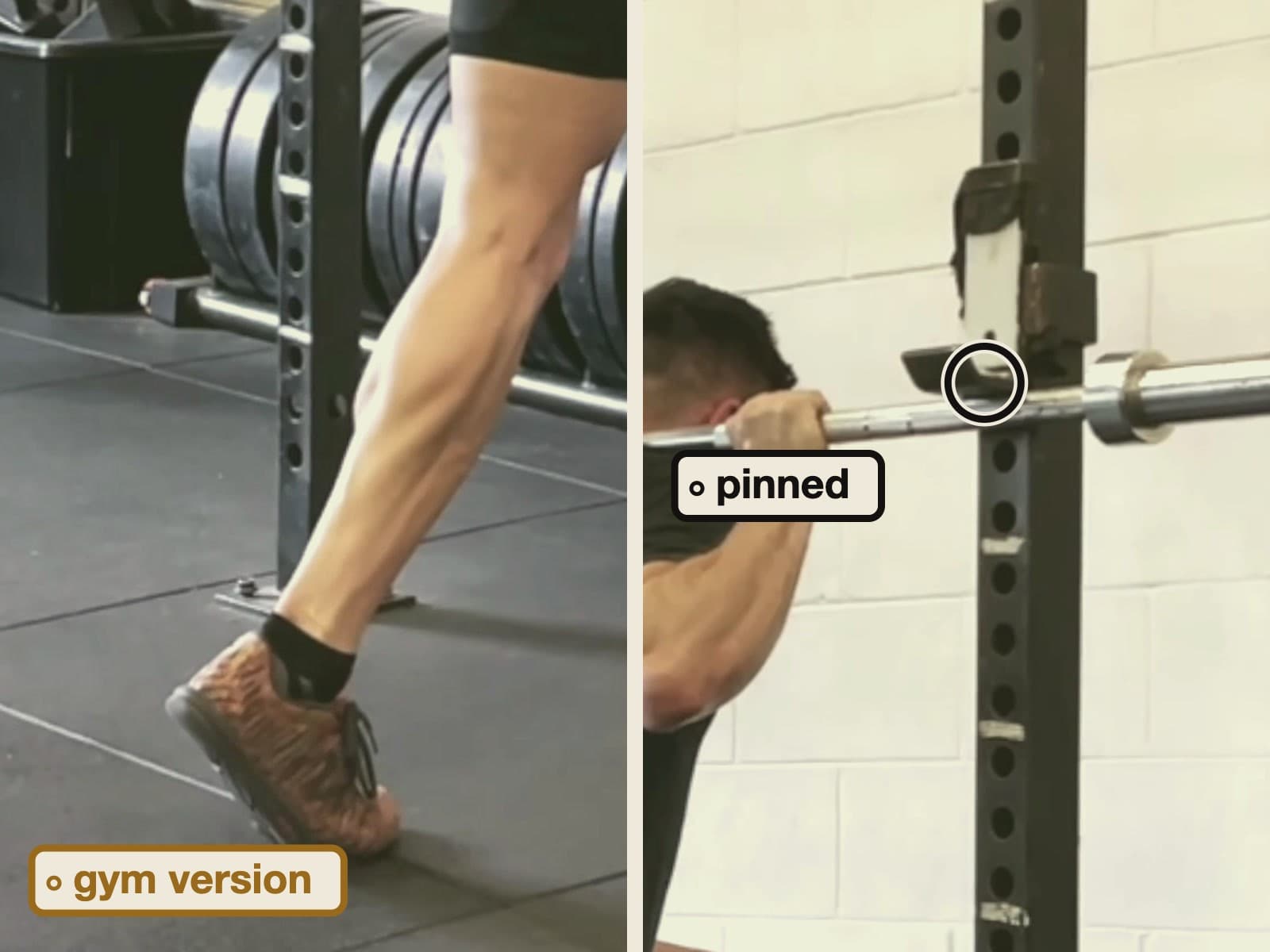
Gym version (rule of thumb for sprinters, not the studied exercise): an isometric calf raise. Two studies we could read in full set the ankle at about neutral, with the knee straight in one of them (Kubo et al., 2017; Tsai et al., 2024). In a rack, with a bar across your upper back, set the safety pins so the bar meets them as your heels leave the floor, then push up into the pinned bar. Without a force scale you cannot read 80% or 90% of max push. Tsai's group put a load scale in line with a harness, a strap and a stirrup, so each push showed its force (Tsai et al., 2024); our rule of thumb for sprinters is a strap under the forefoot with a load scale in line.
2. Ankle joint: hops and low drop jumps
Hops and low drop jumps raised ankle-joint stiffness in one study, where heavy calf raises brought no clear change (Kubo et al., 2007). That study measured the ankle only, during the landing of a drop jump. No study cited here measured a training effect on knee-joint stiffness.
| Exercise | Load | Sets and reps | Per week | Weeks | Who | Result | Source |
|---|---|---|---|---|---|---|---|
| One-leg hops, and drop jumps from 20 cm, on a sliding-seat machine | 40% of 1RM machine load | 5 × 10 of each, 30 s between sets | 4 | 12 | 10 untrained men | ankle-joint stiffness rose; tendon stiffness showed no clear change | Kubo et al., 2007; machine and dose as described by Kubo et al., 2017 for the shared protocol |
Gym version (rule of thumb for sprinters, not the studied exercise): standing pogo hops with nearly straight knees, and low drop jumps from about 20 cm. You land with full body weight, not a 40% machine load, so start well below the study's 5 × 10.
3. Whole leg: sled sprints
In a review of training studies, resisted (sled) sprints had a large effect on leg stiffness (SMD 0.80) and jump training a small one (SMD 0.38) (Bandara et al., 2025).
| Exercise | Load and volume | Per week | Weeks | Who | Result | Source |
|---|---|---|---|---|---|---|
| Sled towing, forward or backward | sled built from 20% to 55% of body mass | 2 | 8 | 115 boys aged 13 to 15 | rose vs controls (effect size 0.94 backward, 0.69 forward) | Uthoff et al., 2021 |
| Sprints from a jogging start, as fast as possible without straining | 2 × (6 × 30 m) in week 1, 2 min between reps and 3 to 4 min between sets, rising to 2 each of 60, 80 and 100 m by week 12 | 1 | 12 | highly trained runners | +11.49% to +15.67% at three test speeds | Thibault et al., 2025; sessions from its full text |
Uthoff's abstract, the only part we could read, gives no sprint distances or rest.
Gym version (rule of thumb for sprinters, not the studied exercise): sled sprints with a load you build over weeks, plus jumps. Those sled loads come from boys aged 13 to 15, and an umbrella review found no established best load (Bruno et al., 2026).
4. Whole body: heavy lifts paired with jumps
In 24 elite long jumpers, an eight-week program of three lift-then-jump pairs raised whole-body stiffness, while strength training alone showed no clear change (Xu et al., 2025). The pairs, from the paper's full text: barbell squats, then 40 cm box jumps; split squats, then 40 cm hurdle jumps; seated one-leg calf raises, then one-leg jumps. The result belongs to the whole program, not to any one pair.
| Exercise | Intensity | Sets and rest | Per week | Weeks | Who | Result | Source |
|---|---|---|---|---|---|---|---|
| One pair from the studied program: squat to a 90° knee, then 40 cm box jumps | squat at 80% to 85% of 1RM | squat 3 × 5; 4 min rest | 2 | 8 | 24 elite long jumpers (12 men, 12 women) | whole program: rose; strength only (squat 5 × 5): no clear change | Xu et al., 2025; pairs, sets and rest from its full text |
The Xu paper is not consistent about the box jump. Its methods say "box depth jumps" and its table says "box jump", so whether they jumped onto the box or dropped from it is unclear.
Gym version (rule of thumb for sprinters, not the studied exercise): pair a heavy lift with a jump through the same joints, such as a set of heavy squats, then jumps onto a box about 40 cm high.
How do I come back after time off?
For sprinters, as a rule of thumb: start the calf pushes as soon as you're back, below your old working load, and ease into hops, drop jumps and sprints while your tendons catch up. If pain hangs around, see a physio. None of the studies cited here tested a comeback plan, so the early calf pushes, the easing back and the physio advice are all rules of thumb, not a tested plan.
Our reason for starting with the calf pushes: in both detraining studies, tendon stiffness was back to its starting level within two months off, and in the knee study, strength held while the tendon's extra stiffness faded.
Sprinters
1. Rule of thumb: start the calf pushes as soon as you're back, below your old working load. One training study began its calf pushes at 70% of max push, 3 sets twice a week, for the first 2 weeks, with 90% in the final 13 weeks (Tsai et al., 2024; start from its full text). The Tsai study was not a comeback study: it started adult men on a new program, and every group in it started the same way, so the start itself was not tested. Our rule of thumb from the Tsai study: after time off, begin your calf pushes and heavy lifts below your old working load and build back.
2. Rule of thumb: ease back into hops, drop jumps and sprints. A review of sprint training calls the weeks after the off-season a particularly vulnerable time for injury in sprinters, and advises gradual familiarisation, in both intensity and duration or repetitions, during the first weeks of a sprint program (Haugen et al., 2019). The same review says aggregated data on how a gap between training speed and competition speed relates to injury in competitive sprinters are lacking. So "gradually" stays a rule of thumb, with no tested number behind it.
3. Rule of thumb: if pain hangs around, see a physio.
Team-sport evidence (observational, not sprinters)
The team-sport studies below concern high-speed running and injury, not tendon stiffness. In one professional Australian football team, large, sudden jumps in high-speed running above a player's usual amount came with more hamstring strains (Duhig et al., 2016). In one squad of 37 elite Gaelic footballers, too little top-speed running was risky too: players who reached over 95% of max velocity at least once in training had lower injury risk than players in the 85%-velocity reference group (Malone et al., 2017). Both studies are observational, and neither included track sprinters.
Distance runners (a different rule)
Rule of thumb for distance runners: keep each run within about 10% of your longest run of the last 30 days. Among 5,205 adult runners (mean age 45.8) in an observational study, a single run more than 10% longer than their longest of the previous 30 days came with more overuse injuries, even when it was only 10% to 30% longer (hazard rate ratio 1.64) (Schuster Brandt Frandsen et al., 2025). These were distance runners, not sprinters, and not specifically back from a break, so we do not apply the 10% to sprint volume. Example: if your longest run of the last 30 days was 10 km, cap the next at 11 km.
Our reason for a per-run rule: the same cohort found no clear link for week-to-week change (Schuster Brandt Frandsen et al., 2025), and in novice runners a randomised trial of a 10%-a-week program had 20.8% injured against 20.3% on a standard one (Buist et al., 2008).
What do the studies not show?
The three studies at the centre of this post (the Achilles study, the calf-raise-versus-hops study and the knee study) used small groups of men who were regularly active or untrained: 9, 10 and 8 men. Nobody has tracked sprinters' tendons through time off yet. None of the stiffness-training studies cited here measured sprint speed, or injuries, in sprinters.
- No sprinters. The tendon-training studies here used untrained men, regularly active men, adults who didn't strength train, adult men and runners. In runners (13 who trained, 13 controls), a 14-week program tabulated at 90% of max push by Bohm et al. (2015) raised tendon stiffness about 16% and cut running energy cost about 4% (Albracht & Arampatzis, 2013). That study did not measure sprint speed.
- No short breaks. Both detraining studies re-tested one month after training stopped, so they cannot say what one or two weeks off does.
- Only the tendon's loss. The detraining evidence here concerns tendon stiffness. For the ankle-joint, whole-leg and whole-body layers, the comeback advice is a rule of thumb.
- One study for the split. The split between calf raises and hops rests mainly on one study of 10 untrained men. A second study by the same first author agreed for the tendon (Kubo et al., 2017); another study found plyometric training raised tendon stiffness 29.4% (Burgess et al., 2007).
- No guessed values. Where the abstracts give no monthly values, this post does not guess them.
What coaches can do with this
None of these training studies used sprinters, so treat each one as a tool for one layer:
- Load the Achilles heavily. Eleven adults who didn't strength train (8 women, 3 men) trained one leg at 90% of max push and the other at 55% for 14 weeks; Achilles stiffness rose only in the 90% leg (Arampatzis et al., 2007). More in our post on the Achilles tendon dose.
- Use heavy calf raises for the tendon, and hops and drop jumps for the ankle. In 10 untrained men who trained one calf each way for 12 weeks, heavy calf raises stiffened the tendon with no clear change at the ankle, and hops and drop jumps stiffened the ankle with no clear change at the tendon (Kubo et al., 2007). More in our post on what limits top speed.
- Rule of thumb: after a break, don't judge the tendon by strength. In the knee study above (8 regularly active men), strength held through 3 months off, while the kneecap tendon's extra stiffness was gone by month 2 (Kubo et al., 2010). In 9 regularly active men aged 21 to 27, the Achilles' 3-month gain was gone 1 month after training stopped (Kubo et al., 2012). Our comeback rules of thumb are in the section above.
- Pair heavy lifts with jumps for whole-body stiffness. In 24 elite long jumpers, 8 weeks of strength training plus jumps raised whole-body stiffness, while strength training alone showed no clear change (Xu et al., 2025).
Images: 3D anatomy from BodyParts3D © DBCLS, CC BY 4.0. Footage stills from "Slow motion athletes" (That's Mr Tigger to You) and "Calf iso pin push" (Science Of Fitness), YouTube.