
Is CNS Fatigue Real? What a Lab Measured After Sprints and Heavy Squats
CNS fatigue is real in a narrow, measurable sense: after a hard session, the brain reaches a little less of the muscle for a day or two. In a 2018 study of ten athletes, that deficit was small, and the muscle itself and the way the athletes felt took longer to come back (Thomas et al., 2018). So the 48 hours between hard days still holds up when the next session needs peak quality. The main reason is not the nervous system, and we would let the gap grow or shrink with the size of the session.

Where did the 48-hour rule come from?
From coaches watching athletes, as far as anyone has traced it. PJ Vazel, a sprint and throws coach in Metz, gave his account on the Pacey Performance Podcast, episode 298 (at 54:32). In the mid-1980s, he says, Charlie Francis saw that Ben Johnson sprinted better at high intensity but could not repeat it on consecutive days. Vazel says the number came from Tudor Bompa's books of the early 1980s, which gave the nervous system 48 hours to recover from high-intensity work. We have not checked Bompa's text.
Derek Hansen, who helped Francis lay out the high-low diagram, walks through it in a talk on his own channel. The original had high at 95 to 100% of best speed, medium at 75 to 95%, and low below that (at 10:08). A typical week ran three high days and three low days in turn, and he started from about 35% high and 65% low, a split Francis gave him. High work covers more than sprints: he lists plyometrics, explosive throws, and dynamic or maximal weightlifting alongside them. Hansen has since widened high to 90 to 100%, to fit in more technical work and volume, and cut low to 65 to 70%, because at 75% athletes too easily ran faster than he wanted.
The authors of the study below note that the idea spread with little peer-reviewed evidence behind it (Thomas et al., 2018).

What did the lab measure?
Kevin Thomas and colleagues at Northumbria University tested ten men with an average age of 21 (Thomas et al., 2018). All had more than three years of training with weights and maximal speed work. They competed at university or national level: six in intermittent sports and four in track and field.
Each man did three sessions, a week apart, in a random order:
| Session | Dose | Rest |
|---|---|---|
| Sprints | 15 × 30 m, maximal | 2 min between sprints |
| Heavy squats | 10 × 5 high-bar back squats at 80% of 1RM (about 101 kg) | 3 min between sets |
| Jump squats | 10 × 5, with about 10 kg added on average | 3 min between sets |

The men did no other training on the test days.
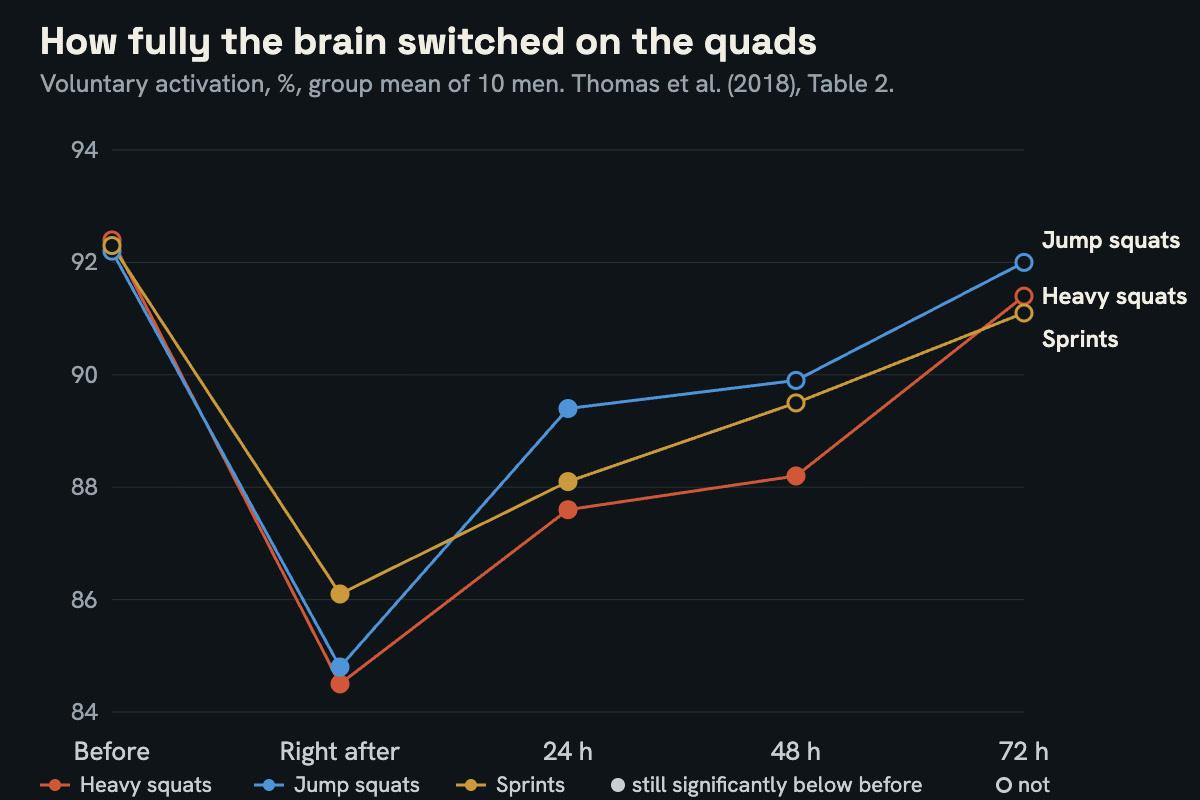
Before each session, just after it, and at 24, 48 and 72 hours, each man pushed as hard as he could with one leg against a fixed sensor. During that push the researchers shocked the femoral nerve and, in separate efforts, stimulated the motor cortex. If a shock adds force to a maximal push, the brain had not fully switched the muscle on. That is voluntary activation.
At 48 hours, compared with before the session:
| Measure | Heavy squats | Jump squats | Sprints |
|---|---|---|---|
| Maximal force | −8%, still down | −7%, still down | −6%, still down |
| Voluntary activation | −5%, still down | −2% | −3% |
| Muscle twitch force | about −5 to −6%, still down | about −5 to −6%, still down | about −5 to −6%, still down |
| How tired they felt (0 to 100 mm, before → 48 h) | 16 → 56, still up | 14 → 30 | 16 → 40, still up |
"Still" means statistically different from before the session. All values are group averages.
Four details change how you read that table.
The drop was small. Voluntary activation fell by six to eight points straight after each session, and by 24 hours it was within 5% of baseline in 6 of the 10 men after the squats, 8 of 10 after the jumps and 6 of 10 after the sprints. The authors call it modest.
The gap between squats and sprints is thin. Activation was still significantly lower at 48 hours after the squats and not after the sprints, but the size of the drop did not differ between the sessions, and the 48-hour averages were 5% and 3%. With ten people we would read that as a hint, not a finding.
Other measures of the brain's output did not change at any point, though the authors note that fast changes may have faded before they tested.
The muscle and the feeling lasted longer. The muscle's own twitch, tested with no input from the brain, was still down at 48 hours after every session. The men also still felt more tired 48 hours after the sprints, when activation had stopped being significantly lower.
The authors' conclusion has two halves. Their data give some support to separating maximal sessions by at least 48 hours when peak performance is the priority, because most measures took 72 hours to clear. But they say recovering the nervous system is not necessarily what that time is for.
They also warn about the dose. These were deliberately high-volume sessions built around one quad-heavy exercise, and they doubt the results carry straight over to normal training, which usually has less volume and more variety. They tested only the knee extensors, on one leg, in a static push. That matters for sprinters: in 15 male academy soccer players after a simulated match, the hamstrings lost more twitch force and less activation than the quads (Massamba et al., 2025). Our PubMed search found no study of activation in a sprinter's hamstrings after a sprint session.
So who is right about CNS fatigue?
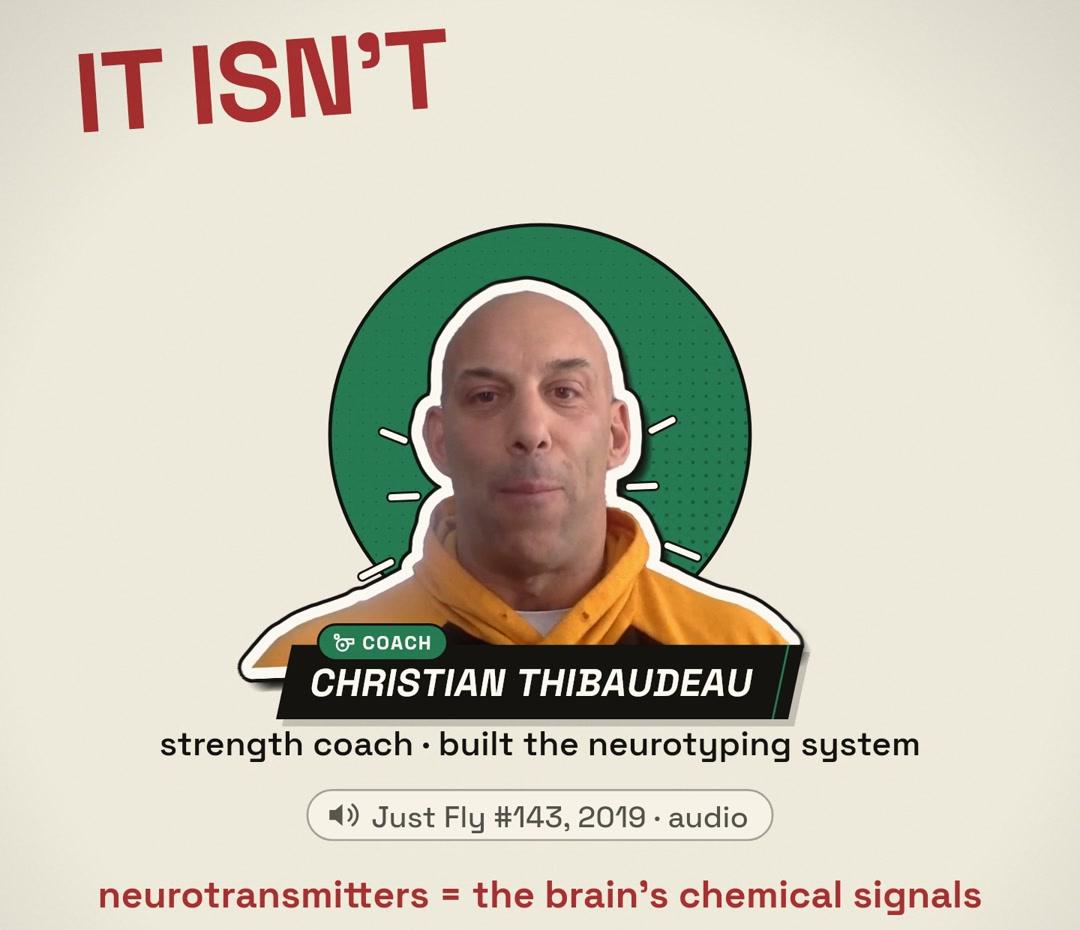
Hansen and the strength coach Christian Thibaudeau look opposed, but they are mostly arguing about the word. Thibaudeau said CNS fatigue "is not a thing" on Just Fly episode 143 (at 96:27), while describing how he reads an athlete who feels flat. The symptoms he lists are low motivation and drive, poor concentration, less pleasure, a lower sex drive and mood swings after very intense work (at 96:40). His explanation is depleted dopamine, or adrenaline receptors that have temporarily stopped responding (at 97:04).
Five years later, on episode 393 (at 13:43), he separates central fatigue from feeling tired. An athlete can feel great, he says, and still not have it in the gym. He adds that much of this is still unknown (at 15:41).
Thomas's team lands in a similar place. They write that what athletes and coaches call central fatigue is more likely fatigue in general, with central and muscle causes mixed together, and that the debate may come down to imprecise terms.
The difference is the evidence. We found no study validating Thibaudeau's chemistry as the reason a sprinter feels flat, so treat it as his model. We have left out his tyrosine supplement test for telling the causes apart: we found nothing validating it, and a 2006 review reported that several well-controlled lab studies showed no positive effect of tyrosine or branched-chain amino acids on exercise capacity or performance in temperate conditions (Meeusen et al., 2006).
Hansen offers 48 to 72 hours as a starting point rather than a measured law. Near the end of the talk he calls a polarized week a good place to start, and says it should make you think about the effect on the body as well as the central nervous system.
The measurement itself is argued over: Thomas's team calls the validity of voluntary activation questionable, and a modelling paper argues that muscle changes alone could produce the force pattern usually put down to central fatigue, though it stops short of refuting the idea (Contessa et al., 2016). A 2017 review says central fatigue after brief, hard exercise typically clears within about two minutes (Carroll et al., 2017), so a dip lasting a day or two is not what it describes for short efforts.
Does the 48-hour rule depend on the size of the session?
We think so, though no study has tested that head-on.
Start with the best-matched athletes we found, doing exercises UK coaches commonly use with elite athletes. Ten international sprinters and horizontal jumpers from the UK's Olympic performance programme did a strength session and a power session on separate days, after the competitive season (Howatson et al., 2016). Six were men with an average 100 m best of 10.44 s; four were women at 11.73 s. The strength session was four sets of five in squat, split squat and push press, loaded to "very hard"; the power session used speed squats, split squat jumps and power presses. Force dropped after the strength session and was still slightly down the next day. The central activation ratio, a similar measure of the brain's drive, and jump height did not change. The authors read that as muscle fatigue rather than nervous-system fatigue, and they caution that central fatigue could have come and gone before their test, 10 minutes after the session.
Hansen tells of asking Francis why high-intensity work ran every day in a 10-day taper when the rule was 48 hours for CNS recovery (Pacey Performance Podcast, April 2018, at 22:08). Francis's answer, as Hansen recounts it, was volume: they were at 40 to 50% of normal high-intensity volume or less, so the hit on the nervous system and the muscles was not the same.
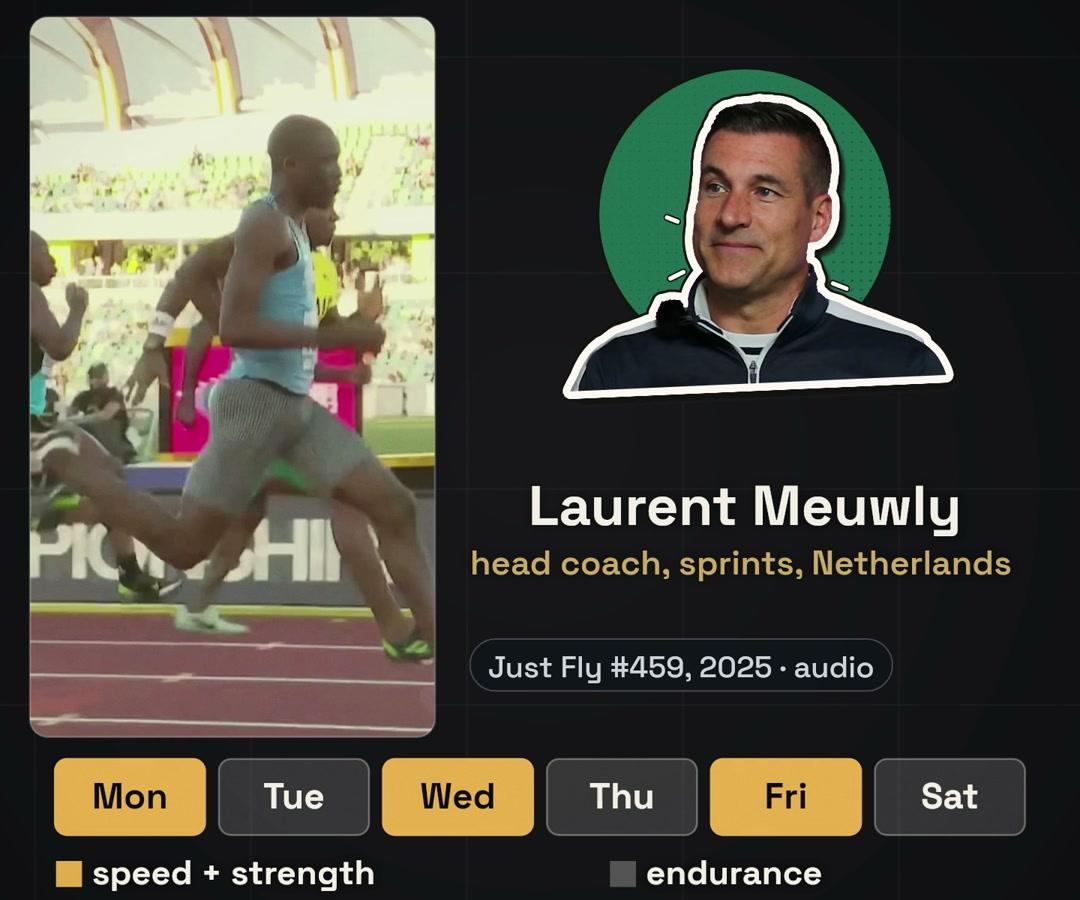
Coaches also change the gap by athlete. Francis gave one overtrained athlete with low tolerance only two high days, spread as far apart as possible, and Hansen says he has started to rethink his own default of three. Laurent Meuwly says his speed-based athletes recover from speed or heavy work faster than his endurance-based ones (Just Fly episode 459, at 42:19). Hansen says that young athletes recover fast because their output is low, and that in his own training he now needs three or even four days between sprint workouts.
Where should the heavy lifts go?
Meuwly stacks them. (Whether a bigger squat helps speed at all is a separate question.) He trains twice on Monday, Wednesday and Friday and once on Tuesday, Thursday and Saturday, with Sunday off, and the two-session days pair speed or speed endurance with strength (at 54:04). He describes a Monday-morning speed session (at 42:59) and big lifts (squats, deadlifts, cleans) on Monday and Friday afternoons; Wednesday afternoon is a lighter circuit for the sprint muscles, with bodyweight, bands or small weights (at 4:45 and 5:51).
We found one test of that idea, in team-sport athletes rather than sprinters. Ten recreational male players with a lifting background did three sessions in a random order: intermittent sprints alone, lower-body lifting alone, or the sprints followed by the lifting an hour later (Cross et al., 2022). The muscle's twitch response fell 36% after the sprints alone, 58% after the lifting alone and 55% after both, and it had recovered by 48 hours every time. Sprinting first did not make the lift's hit on the muscle any worse, and they lifted the same volume and load. Voluntary activation did not change in any condition, though soreness was still up at 48 hours.
That is one session, in non-sprinters. We found no study comparing a stacked week with a split week in sprinters over time.
Boo Schexnayder reaches the same goal another way. With postgraduate athletes he may write a three-day rollover: a power day, a high-end speed or power day, then a restoration day and a day off, before checking whether they are ready for the next block (Just Fly episode 205, at 22:59). When he runs hard days back to back, he expects at least one, and more often two, restoration days after them (at 52:36).
What can coaches do with this?
These are small studies, and none tested a sprinter's training week. Within those limits:
- After a big maximal session (Thomas's ten athletes did 50 heavy reps, or 15 × 30 m), try at least 48 hours before the next hard day when you need top quality. Most measures took 72 hours to clear.
- Try putting heavy lifting on a speed day with the sprints first, as Meuwly's Monday does. In Cross's ten team-sport men, sprinting an hour before lifting cost the muscle no more than lifting alone.
- If you need another hard exposure inside 48 hours, try cutting the volume first. Francis's taper ran daily high-intensity work at 40 to 50% of normal volume or less, by Hansen's account. What a sprint session should look like covers the session itself.
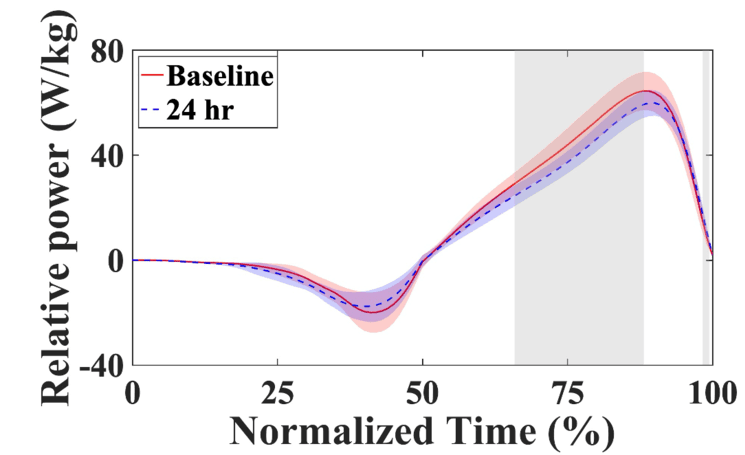
- Measure flatness instead of naming it. In ten male college 400 m sprinters, jump power was still down 24 hours after a 400 m fatigue protocol (Hasegawa et al., 2024). A jump before the next speed day gives you a number, not the cause.
FAQ
- Does feeling tired mean the nervous system is fatigued?
- Not by itself. In Thomas et al. (2018), the men felt more tired at 48 hours after the sprints, when voluntary activation had stopped being significantly lower. Thibaudeau makes the same point from the other side: an athlete can feel great and still be down.
- Is a jump session easier to recover from than sprints or squats?
- In Thomas et al. (2018), session RPE averaged 5 for the jump squats, 8 for the heavy squats and 6 for the sprints; the jumps were rated significantly easier than the squats, but not than the sprints. How tired the men felt was no longer significantly raised at 48 hours after the jumps, though maximal force was still down. The authors warn that the sessions cannot be matched, since jump squats move less load through less range.
- Does this apply to women?
- Thomas tested only men. Howatson's group included four women, whose force dropped after the power session as well as the strength session, while the men's held after the power session; the authors say small numbers limit that. Hansen's view, which no study here tests, is that men need a little more recovery and women can do more high-intensity volume.
Figures: coach images and sprint footage are stills from public videos, podcasts and race broadcasts. The voluntary activation chart is our drawing of the group means in Thomas et al. (2018), Table 2. Squat clip from "Noah Lyles Excellent Strength & Conditioning!" (Sika Strength, YouTube). Jump-power panel: Figure 4 from Hasegawa et al. (2024), PeerJ, CC BY 4.0, cropped to the 24-hour panel.