
How Heavy Should a Sled Be for Sprinters? What the Studies and Coaches Disagree On
No single sled load suits every sprinter. A 2026 umbrella review of 15 systematic reviews found no universally best load or method (Bruno et al., 2026). The answer moves with two things: the ruler you use (percent of body weight or percent of speed lost) and who is pulling. Resisted sprinting has its best-supported results over 20 m or less, mostly in young male team-sport athletes. Stu McMillan says his fast sprinters got slower on heavy loads, and the reasons he gives are the most useful part of this debate.
Why do sled studies give such different loads?
Studies mostly set a sled load one of two ways: a percent of body weight, or the percent of top speed the sled takes away. The two don't convert. Here is what it took to cost an athlete about half their top speed.
| Who | Surface | Load, as % of body weight |
|---|---|---|
| 12 junior sprinters, half of theoretical top speed (Zisi et al., 2022) | Synthetic track | 57 to 73% |
| 70 high-school team-sport athletes (Cahill et al., 2019) | Artificial turf | 71 to 107% |
| 12 recreational athletes and 15 sprinters, load for peak power (Cross et al., 2017) | Depends on friction | 69 to 96% |
| 9 pro soccer players (Lahti et al., 2020) | Artificial turf | about 94%, sled included |
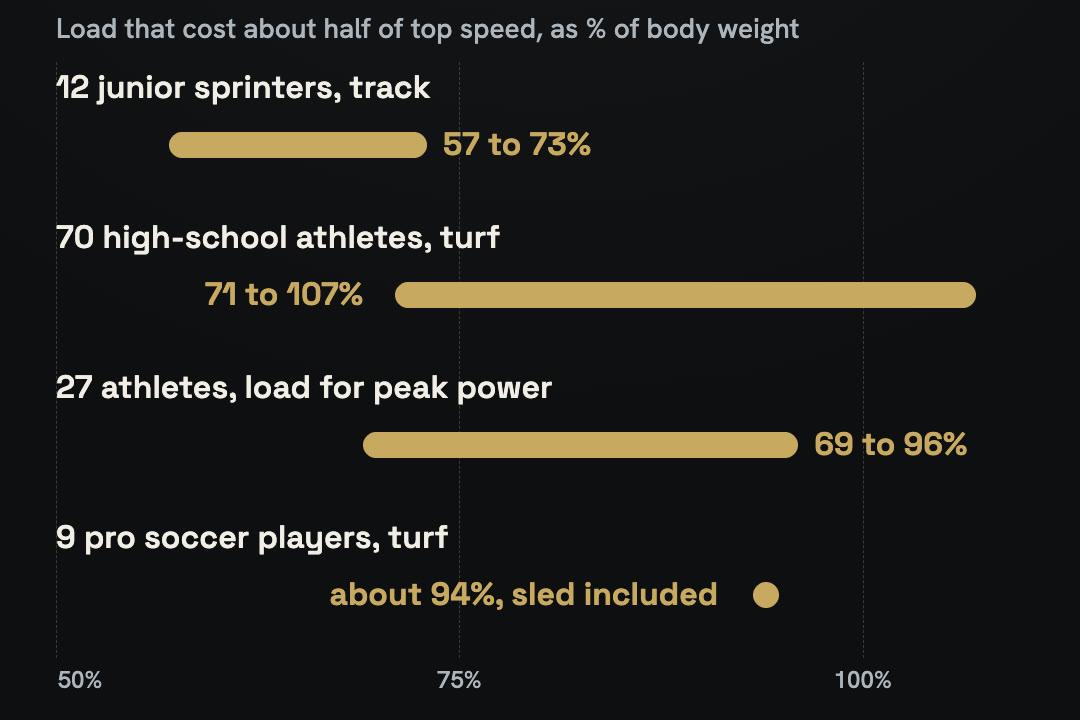
Inside that group of 70 teenagers, the same target ran from 71% to 107%. Hand that squad one percent and every athlete gets a different session.
George Petrakos, lead author of a 2016 review of sled studies, makes the same point in a Pacey Performance roundtable. A body-weight percent is quick for large groups, he says, but it ignores the individual and stops meaning the same thing when the surface changes. After a day of rain he treats earlier testing as void.
So why do so many coaches aim at 50%? It is where an athlete's sprinting power peaks on the speed-power curve (Stavridis et al., 2023). In one study, that peak came at 4.19 m/s in recreational athletes and 4.90 m/s in sprinters (Cross et al., 2017).
Håkan Andersson, a sprint coach of more than 35 years by his own account, explains why that speed is useful. Against a load of about 60% of body weight, a sprinter who can reach 11 m/s moves at about 4 to 5 m/s, the speed of his first or second stride. So a heavy sled stretches out the first strides: in the roundtable he says one rep can give about 20 nearly identical steps.
If you use a motor, don't read its kilos as sled kilos. Andersson says about 30% of body weight on a motorised system is equivalent to about 60% on a sled, depending on friction. McMillan's 30 kg was on a motor. A 1080 does report speed on every run: against force plates in 12 male athletes, its step-averaged speed showed a small fixed bias of 0.11 m/s (Sugisaki et al., 2024).
If you have timing gates, Petrakos recommends working out the speed loss. Take each athlete's best 0 to 20 m without a sled and turn it into average speed. Then time a few sled loads and see what each costs. If 0 to 20 m takes 3.00 s (6.67 m/s) and a sled rep takes 6.00 s (3.33 m/s), that load costs 50%. (Round numbers, to show the sum.) With no gates, he uses a sled one-rep max: keep adding weight until the rep stops looking like a sprint.
What did the training studies prescribe?
| Study | Who | Load | Sled work | Result without the sled |
|---|---|---|---|---|
| Jia et al., 2025 | 32 male teen sprinters, 3+ years' training | 25, 40 or 50% of body weight | Twice a week, 8 weeks: 3 sets of 6 × 30 m (2 min between reps, 3 min between sets), then 3 × 60 m unloaded | 40% and 50% improved 30 m more than no sled; 25% improved 60 m |
| Rodríguez-Rosell et al., 2022 | 60 physically active men | 0, 20, 40, 60 or 80% of body weight | Once a week, 8 weeks | 0, 40 and 60% improved; 20 and 80% showed no relevant change |
| Stavridis et al., 2023 | 27 sprinters | 50% speed loss, 10% of body weight, or no sled | 12 sessions in 6 weeks: 2 sets of 5 sprints | Only the 50% group improved, at every 5 m split to 30 m |
| Cahill et al., 2020 | 53 male high-school athletes | 44, 89 or 133% of body weight (25, 50, 75% speed loss) | Twice a week, 8 weeks | All sled groups improved 5, 10 and 20 m; no sled did not; heaviest gained most |
| Lahti et al., 2020 | 9 pro soccer players | about 94% of body weight, sled included | 9 weeks, 20 m reps, 3 min rest, about 37 sprints in all | 0 to 10 m beat a team doing no systematic acceleration work |
| Cross et al., 2018 | 36 club soccer and rugby players | 50% or 10% speed loss | 12 sessions of 10 × 20 m | Both minor: split times 1.4 to 2.3% better |
| Maviel et al., 2026 | 17 pro rugby backs, in season | 1080 at 50% of top speed | Once a week, 4 × 15 m | Propulsive power +4.5%, top speed +2.7%; no significant change in 11 backs from the season before |
Load trades against volume. Jia's sprinters had 18 sled reps a session, 288 planned over the study. Lahti's soccer players, pulling about twice as much relative to body weight, finished about 37 (our arithmetic on both). A 2025 meta-analysis of 49 studies found the same trade: heavy loads at small volumes matched light loads at large volumes (Xu et al., 2025).
The gains are small. In that meta-analysis, sled training beat plain sprinting by a small margin (effect size −0.30), and not at every load: 20 to 50% of body weight and 80% or more did; light loads and the 50 to 80% band did not.
Sprinters are rare in this table. Only Jia and Stavridis studied them, and Jia's were amateur to regional level.
One detail we would copy from Jia's paper: coaches put markers on the track for step length and timed every sled rep, to keep the athletes at full effort.
Why did Stu McMillan's fast sprinters get slower?
McMillan, who has coached 70 Olympians, says that for probably two years he chased a 50% speed loss, and almost all his fast athletes got worse. In the same talk he goes further.
He says they got stronger, and better at 30 kg resisted runs, but slower without the load. His reading: elite sprinters put huge force into the ground very early in contact, and the load pushed them the other way. He describes making stiff, elastic sprinters "more compliant and more grindy". A couple of years later he began taking weight off.
He also explains why the papers disagree with him: in his view they mostly train soccer players who don't push well to begin with, so teaching them to push transfers.
Does the research back him? Partly.
For him: in Cahill's high-school athletes, the heaviest group gained most over 5 to 20 m, yet its theoretical top speed fell, while the no-sled group's rose (Cahill et al., 2020). And Cross's training study ended close to where McMillan does: results varied widely, and adaptations may depend on each athlete's starting force-velocity profile (Cross et al., 2018).
Against him: Stavridis's 50% group of sprinters improved at every split, with a higher step frequency. The 2025 meta-analysis found heavier loads worked best in trained and highly trained athletes, with no clear benefit of higher loads in recreational groups (Xu et al., 2025). That runs against the idea that heavy sleds only help people who can't run.
Our read: none of these studies ran for two years, we could not confirm that any tested athletes as fast as McMillan's, and his account has no test data or control group. So both can be true.
What he does now: the lighter and faster the athlete, the lighter the resistance, which is how he reads a 2025 study of 123 college football players. With two athletes he calls really elastic, he stays under 10 kg on the 1080, nearly always with a resistance that fades as they speed up. For an 11.07 s woman who produces big forces but takes too long to apply them, he may skip resisted accelerations and work on elastic strength.
Jason Hettler, who programmed ALTIS sprinters, says an optimal-power load for the men was more than the 1080 could give, so they judged reps by eye. Dr. Ken Clark sits on the other side: working up to a 50% speed loss with team-sport athletes, he reported no problems in a 2020 interview, judged by his coach's eye and not a measurement.
When in the season do coaches go heavy?
| Coach, athletes | Early | Later | Their limit |
|---|---|---|---|
| Jason Hettler, ALTIS sprinters | Very heavy, first 3 to 5 steps, about 5 m | Load comes down toward none as distance goes out; then resisted reps alternate with belt-off reps | Backs off when reps look out of control; may cut the session if speed drops |
| Håkan Andersson, sprinters | Fairly heavy for a couple of weeks | Gradually lighter, moving along the acceleration curve | No heavy sled right before top-speed sprinting |
| Ken Clark, team-sport athletes | Empty sled, a little more each week | About 50% speed loss by week 4 or 5 | No sled past 20 yards himself; if you do, light and on a waist harness |
| Dr. Micheál Cahill, team-sport athletes | Sled after the fastest work, before the weight room | Heavy pull means fewer bilateral squats | Reps end at about 5 s; 3 min rest |
Hettler also names what keeps heavy work from changing a sprinter: he could go heavy on acceleration days because four other days that week had unresisted sprints. A squad sprinting twice a week has much less of that cover (our read).
Andersson's favourite session lets the load fall away during the rep: for example, 10 kg at the start and 5.5 kg at 30 m. Petrakos has a warning about pairing the other way: an athlete going from a very heavy sled straight into an unresisted sprint can nearly fall over.
Does a heavy sled change sprint form for good?
During the rep, yes. At the second step, hip angle at push-off fell from 177.0° with no sled to 170.8° at a 20% speed loss and 169.5° at 30% (Osterwald et al., 2021). The authors suggest athletes may not be strong enough for full extension under load, and say it is unknown whether the change helps or hurts. Steps shortened by about 10% at 12.6% of body weight and 24% at 32.2% (Lockie et al., 2003). Andersson says the shorter step comes mostly from flight, with contact length about the same and step rate barely changing.
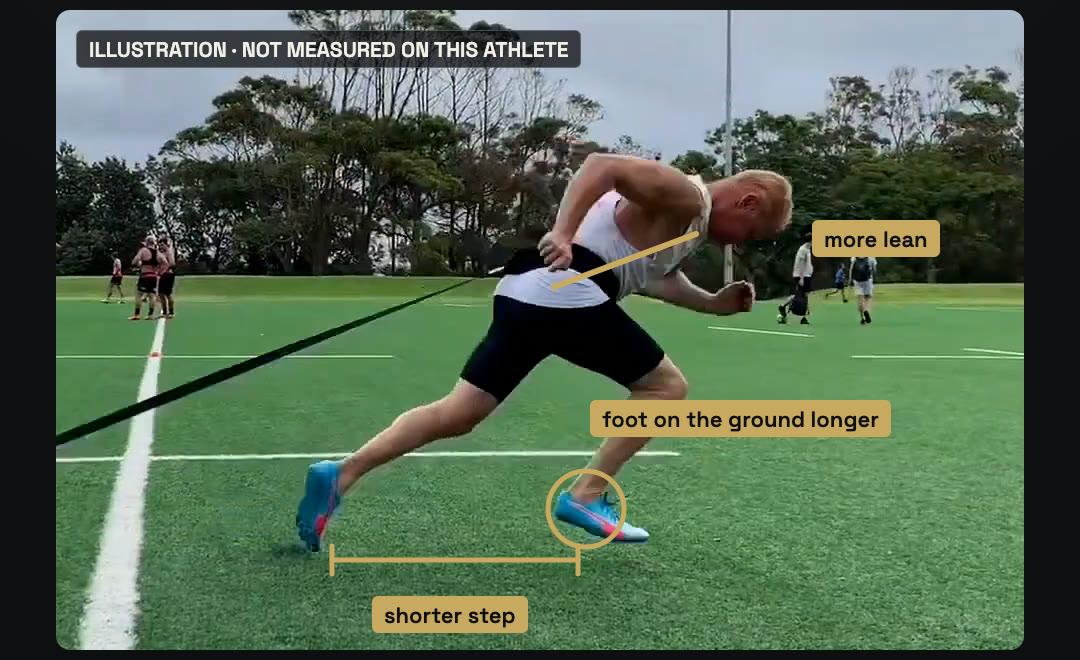
After the sled comes off, the measured evidence is reassuring so far. Lahti's set-up is the part to study: two weeks of familiarisation, radar checks in week 1 that each sled speed sat on target, 20 m sprints with no sled in every session, and the same cues for everyone. After 9 weeks, no technique change passed the minimal detectable change. The limits: nine soccer players, and no group doing unresisted sprint training.
Jia's teenagers moved the right way in their unloaded tests: step length rose within every sled group, and the 40% and 50% groups improved trunk angle at toe-off.
Worried about transfer anyway? Petrakos suggests fast-contact work between heavy reps: bounds, bunny hops, drop jumps. Cahill uses the 3 minutes for foot and core work.
What does "too heavy" look like?
Every coach here watches the rep, whatever else he measures.
- Arms flailing, as if running through mud: Petrakos's failed rep.
- A break at the hips, losing the line from ear to heel: Cahill says force then goes down instead of forward.
- The heel squashing down and a bulge at the back of the ankle: Cahill's Achilles sign.
- Moving through hip flexion instead of extending: what Andersson watches for.
- Speed falling from where it settled: Hettler's cue to stop.

Try filming from the side, next to the athlete's own unloaded start, on the same step. Alcaraz's group recommended that overlay and said to watch forward lean and support-leg angles (Alcaraz et al., 2008). Don't fail every ankle bend: in 14 male sprinters, more ankle bend early in stance went with a higher ratio of forces (King et al., 2022). Cahill's sign is the visible collapse.
What coaches can do with this
None of this is a tested plan. These are starting points from the people above.
- Developing sprinters with a few years' training: Jia's teenagers used 40 to 50% of body weight, twice a week for 8 weeks.
- Team-sport athletes: Clark's ramp from an empty sled, or in season, Maviel's once-a-week 4 × 15 m at a 50% speed loss on a 1080.
- Very elastic athletes: with two of his, McMillan stays under 10 kg on a 1080, with a resistance that fades. Strong but slow to apply force: he may skip resisted accelerations altogether.
- Whatever the load, try timing the unloaded sprint every few weeks. McMillan's athletes improved on the resisted run and got slower off it, so the sled number alone won't warn you. Use the same start and setup, and avoid hand timing over 10 to 20 m (Haugen & Buchheit, 2016).
Related: what limits top speed and does a bigger squat make you faster.
FAQ
- Does the sled's own weight count?
- Studies differ. Lahti's 94% includes a 21 kg sled. Jia's paper doesn't say: its sled weighed 16.5 kg, about what 25% works out to for a 66 kg sprinter (our arithmetic), so that group may have pulled a nearly empty sled.
- Where did the 10% rule come from?
- Older advice kept the speed loss near 10%, on the theory that heavy loads disrupt mechanics. Kawamori's group noted in 2014 that it had not been tested (Kawamori et al., 2014). Andersson says nobody really knows its origin.
- Should a heavy sled come right before a sprint?
- Results split. Twelve junior sprinters ran 30 m faster 8 minutes after two heavy sled sprints (Zisi et al., 2022). Across 14 studies of competitive sprinters, warm-up sprints, jumps and strength work of this kind made no clear difference (Loturco et al., 2024).
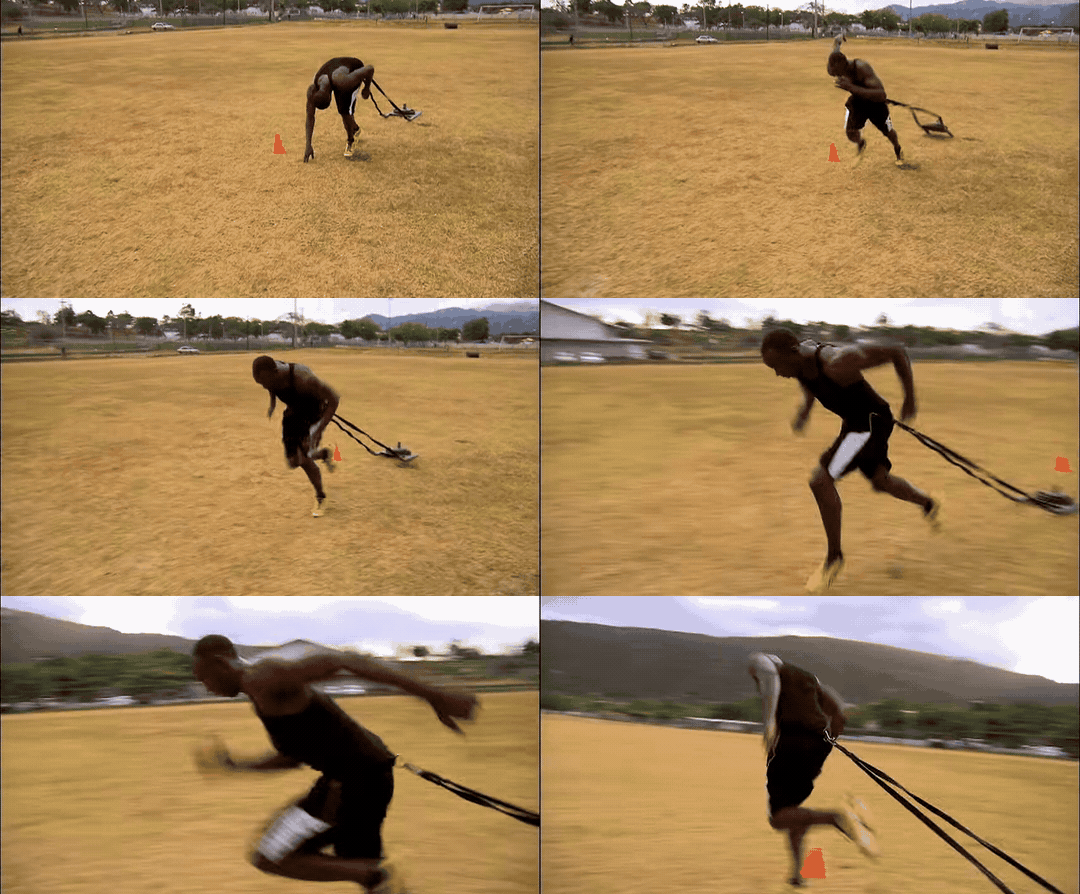
Figures: our range chart of the numbers in Zisi et al. (2022), Cahill et al. (2019), Cross et al. (2017) and Lahti et al. (2020). Sled frames from "Resisted Sled Sprints" (Peter Mamo, YouTube) and a Christian Coleman block-start training video (Sprint Technique, YouTube). Sled clip from "Usain Bolt - Train Like Usain" (Fastest Man, YouTube).